Arizona EMS protocols,
in your pocket.
Offline, county-specific protocols for Arizona EMS providers — searchable, with a full medication reference, hospital finder, and study tools built in.
Covering 15 counties in Arizona · Protocols current as of June 5, 2026
See it in the field
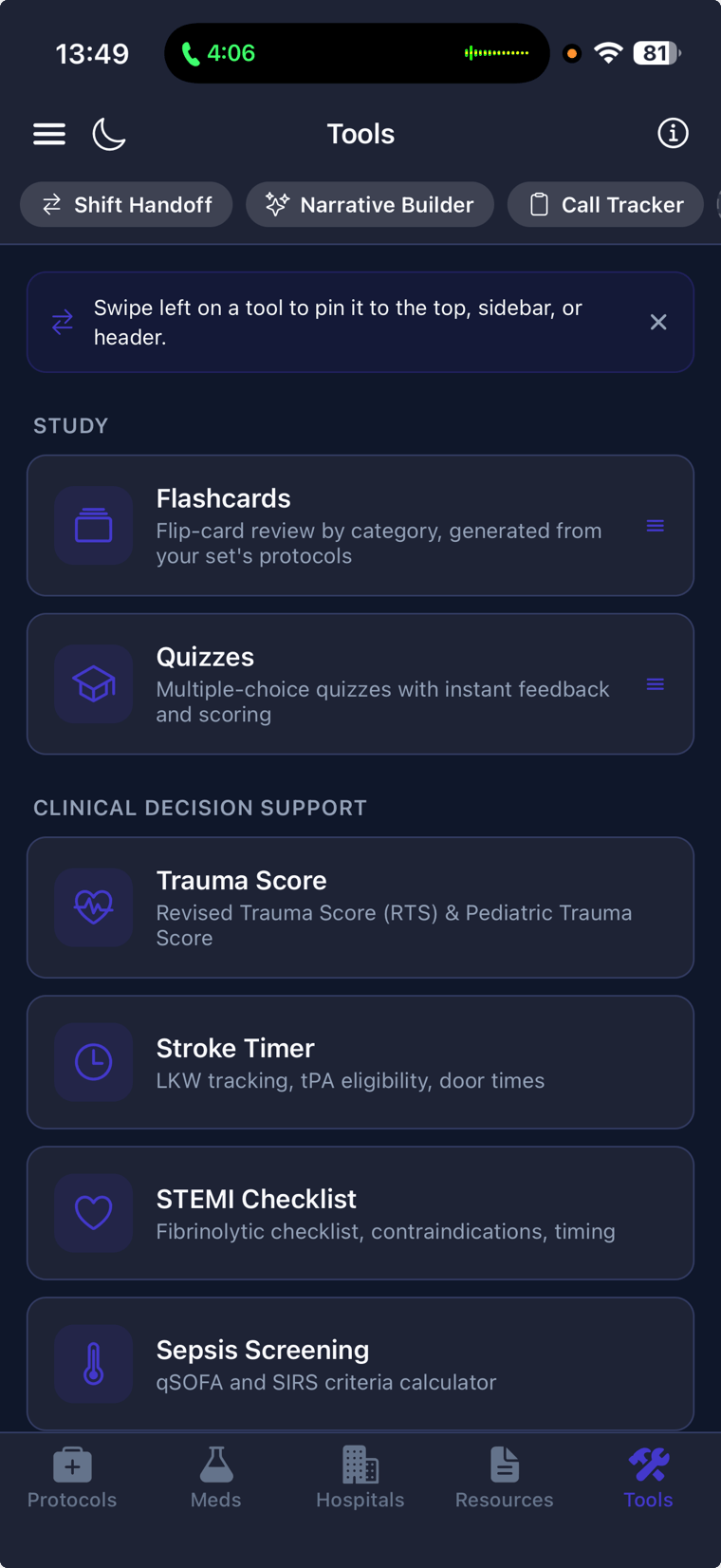
Pocket Protocols showing Arizona's protocols, medications, and hospitals — searchable and fully offline.
What's covered in Arizona
The protocol set serving Arizona right now.
Arizona Statewide Guidance
Study tools for Arizona Statewide Guidance
A few real flashcards and quiz questions from Arizona's own protocols — the full set, plus a spaced-review deck, is in the app.
Flashcards
Why is the needle advanced over (superior to) the lower rib during NDC?
Adult TBSA: Anterior and posterior leg percentages
Genitalia/Perineum TBSA – across all age groups
Anterior and Posterior Torso TBSA – Infant vs. Child/Adult
Anatomical Landmarks for NDC: AAL Site Identifiers (A, B, C)
Bradycardia protocol inclusion criteria
CPR in TAH patients — is it indicated?
Adult Tachycardia with a Pulse: Definition & Exclusions
Quiz questions
According to the protocol, what is the MOST important factor when determining whether a tachycardic patient requires cardioversion?
- The patient's heart rate exceeding 150 bpm
- ✓ Hemodynamic instability
- Altered level of consciousness alone
- Patient complaint of palpitations
A paramedic is treating a stable adult patient with SVT. Vagal maneuvers have failed. The paramedic administers 6 mg of Adenosine IV/IO, but the tachycardia continues. What is the correct next step according to the protocol?
- Administer a second dose of 6 mg Adenosine IV/IO followed by a 10 mL fluid bolus.
- ✓ Administer 12 mg Adenosine IV followed by a 10 mL fluid bolus.
- Immediately perform synchronized cardioversion.
- Administer 0.25 mg/kg Diltiazem IV/IO without further Adenosine.
During the chest-pain assessment, you identify symptomatic bradycardia with hemodynamic compromise. Which action does the EMT section explicitly direct immediately after Universal Care?
- Administer aspirin 325 mg PO or chewed
- Administer oxygen to maintain SpO2 ≥ 94%
- ✓ Immediately address any signs of cardiac arrest, symptomatic tachycardia, or symptomatic bradycardia
- Acquire and transmit a 12-lead ECG within 5 minutes of patient contact
You respond to a VAD patient who appears pale, diaphoretic, and has an altered mental status. The VAD appears to be functioning. As an AEMT, what is the correct fluid bolus order?
- 20 mL/kg IV/IO over 20 minutes, maximum 500 mL
- ✓ 30 mL/kg IV/IO over less than 15 minutes, maximum 1 L, using push-pull method or pressure bag
- 1 L IV/IO wide open, then reassess
- 500 mL IV/IO over 30 minutes, may repeat once
You are called to treat an unresponsive adult patient with a Total Artificial Heart (TAH). Bystanders urge you to begin CPR immediately. According to protocol, what is the correct action?
- Begin CPR immediately, as you would for any unresponsive patient.
- ✓ Never perform CPR for TAH patients.
- Perform CPR only if the pneumatic thumping sound is absent.
- Perform CPR at half the normal compression rate to protect the device.
You are an EMT transporting a post-ROSC adult patient who is not breathing spontaneously. ETCO2 is unavailable. At what ventilation rate should you maintain the patient?
- 8 breaths per minute
- ✓ 10 breaths per minute
- 12 breaths per minute
- 20 breaths per minute
Sourced from Arizona's EMS authority
Pocket Protocols brings Arizona's EMS protocols into a faster, fully offline app.
Arizona protocols — FAQ
Are Arizona's EMS protocols available offline?
Are the protocols specific to my county in Arizona?
Is Pocket Protocols official, or affiliated with Arizona?
How do Arizona protocol updates reach the app?
Carry Arizona's protocols on every call.
Download Pocket Protocols and keep your county's complete protocol set in your pocket — online or off.