Arkansas EMS protocols,
in your pocket.
Offline, county-specific protocols for Arkansas EMS providers — searchable, with a full medication reference, hospital finder, and study tools built in.
Covering 75 counties in Arkansas · Protocols current as of June 6, 2026
See it in the field
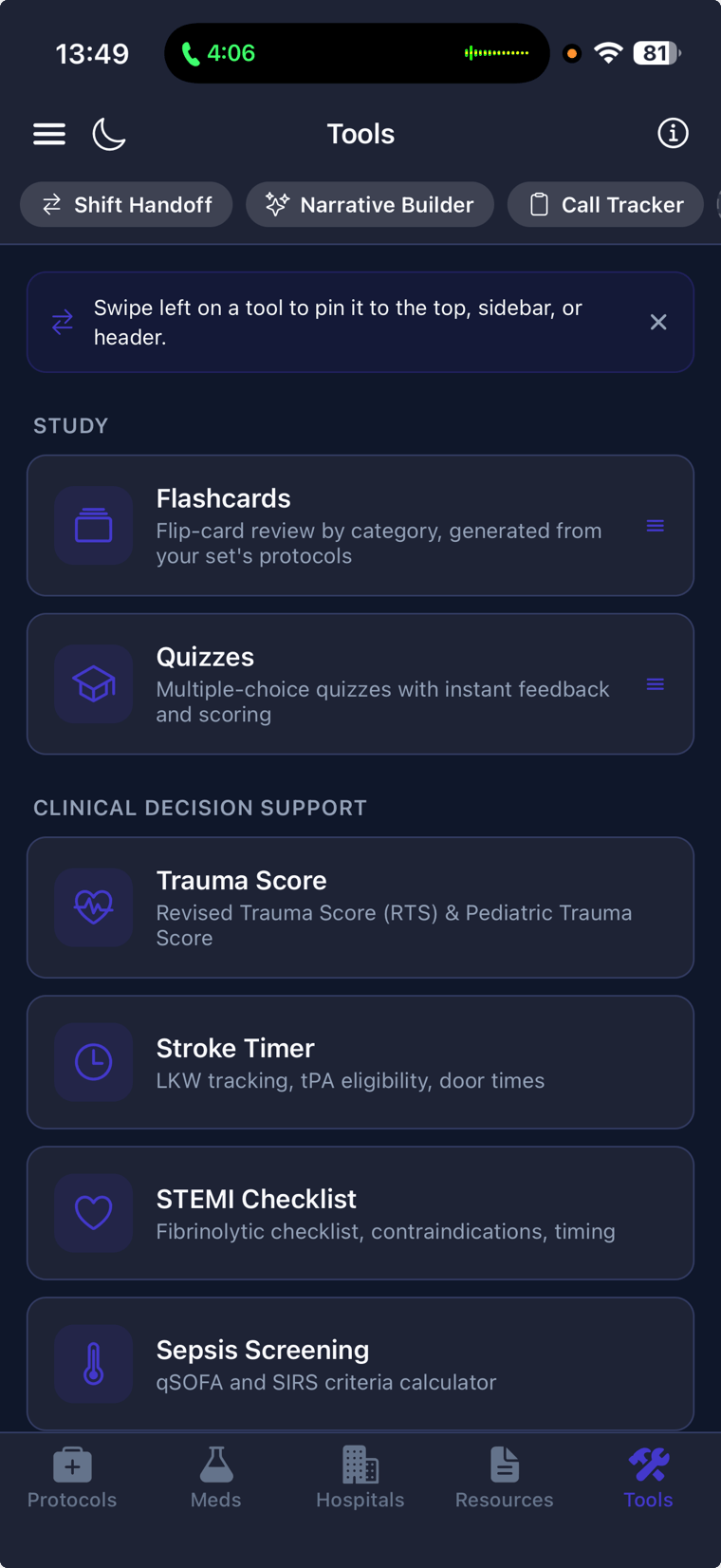
Pocket Protocols showing Arkansas's protocols, medications, and hospitals — searchable and fully offline.


What's covered in Arkansas
The protocol set serving Arkansas right now.
Arkansas Adopted Statewide Guidelines
Study tools for Arkansas Adopted Statewide Guidelines
A few real flashcards and quiz questions from Arkansas's own protocols — the full set, plus a spaced-review deck, is in the app.
Flashcards
Rule of Nines – adult head and leg % TBSA
TBSA estimation – obese adult (80 kg) key differences
Obturator: function and critical action after tracheostomy insertion
What is the purpose of obtaining a prehospital 12-lead ECG in suspected STEMI?
Bradycardia inclusion criteria (adult)
How do you assess for VAD pump malfunction in the field?
What are the four cardiac arrest rhythms addressed in the NASEMSO Cardiac Arrest protocol?
EtCO2 threshold for termination of resuscitation in asystole/slow wide complex PEA
Quiz questions
According to the NASEMSO National Model EMS Clinical Guidelines, which diagnostic tool is specifically highlighted in the literature for improving identification of ST-segment elevation myocardial infarction (STEMI) in the prehospital setting?
- Point-of-care troponin testing
- ✓ Serial prehospital 12-lead electrocardiograms
- Continuous pulse oximetry monitoring
- Prehospital echocardiography
You arrive on scene to find a 17-year-old male who collapsed while playing basketball. Bystanders report he lost consciousness briefly but is now awake and alert. He has no prior cardiac history. According to the protocol, what is the most appropriate next action regarding his disposition?
- Allow him to refuse transport since he has fully recovered and has no cardiac history.
- ✓ Transport to the emergency department, as syncope during exercise often indicates an ominous cardiac cause.
- Consult medical direction for a delayed or non-transport decision, as vasovagal syncope is most likely in a young, healthy patient.
- Administer a fluid bolus and reassess; transport only if he does not improve.
An adult patient presents with a heart rate of 42 BPM, diaphoresis, and hypotension. Atropine 1 mg IV has been given twice with no improvement. Which of the following is the MOST appropriate next intervention according to the protocol?
- Administer a third dose of atropine 1 mg IV immediately
- ✓ Initiate vasopressor therapy (e.g., epinephrine IV drip 0.02–0.2 mcg/kg/min) or transcutaneous pacing
- Administer dopamine as the first-line vasopressor
- Withhold further treatment and monitor the patient closely
You arrive on scene to find an LVAD patient who is unresponsive and appears to have no signs of life. Before initiating CPR, what TWO conditions must BOTH be confirmed according to the protocol?
- The patient has no palpable pulse AND ventricular fibrillation is confirmed on the cardiac monitor
- ✓ The pump has stopped AND troubleshooting efforts to restart it have failed
- The VAD coordinator has been contacted AND has given verbal authorization for CPR
- The patient is unresponsive AND the VAD travel bag with spare controller is unavailable
You arrive on scene to find a 68-year-old male with sudden onset of right-sided facial droop and arm weakness. His blood glucose is 82 mg/dL and his systolic BP is 118 mmHg. Per his wife, he was speaking normally at 0800 and it is now 1215. Which action is MOST consistent with this protocol?
- Treat hypertension before transport to reduce hemorrhagic conversion risk
- ✓ Elevate the head of the stretcher 15–30 degrees and provide early hospital notification including suspected LVO
- Withhold oxygen because his SpO2 is 96%
- Delay transport to obtain a second 12-lead EKG on scene
You arrive on scene to find an adult patient in cardiac arrest with no bystander CPR in progress. Your partner begins setting up the defibrillator. According to the protocol, what is the MOST appropriate immediate action?
- Wait for the defibrillator to be ready before touching the patient
- ✓ Initiate chest compressions immediately while your partner sets up the defibrillator
- Perform a detailed history and physical exam before starting compressions
- Apply a non-rebreather mask and begin passive ventilation before compressions
Sourced from Arkansas's EMS authority
Pocket Protocols brings Arkansas's EMS protocols into a faster, fully offline app.
Arkansas protocols — FAQ
Are Arkansas's EMS protocols available offline?
Are the protocols specific to my county in Arkansas?
Is Pocket Protocols official, or affiliated with Arkansas?
How do Arkansas protocol updates reach the app?
Carry Arkansas's protocols on every call.
Download Pocket Protocols and keep your county's complete protocol set in your pocket — online or off.