California EMS protocols,
in your pocket.
Offline, county-specific protocols for California EMS providers — searchable, with a full medication reference, hospital finder, and study tools built in.
Covering 17 counties in California · Protocols current as of October 7, 2026
See it in the field
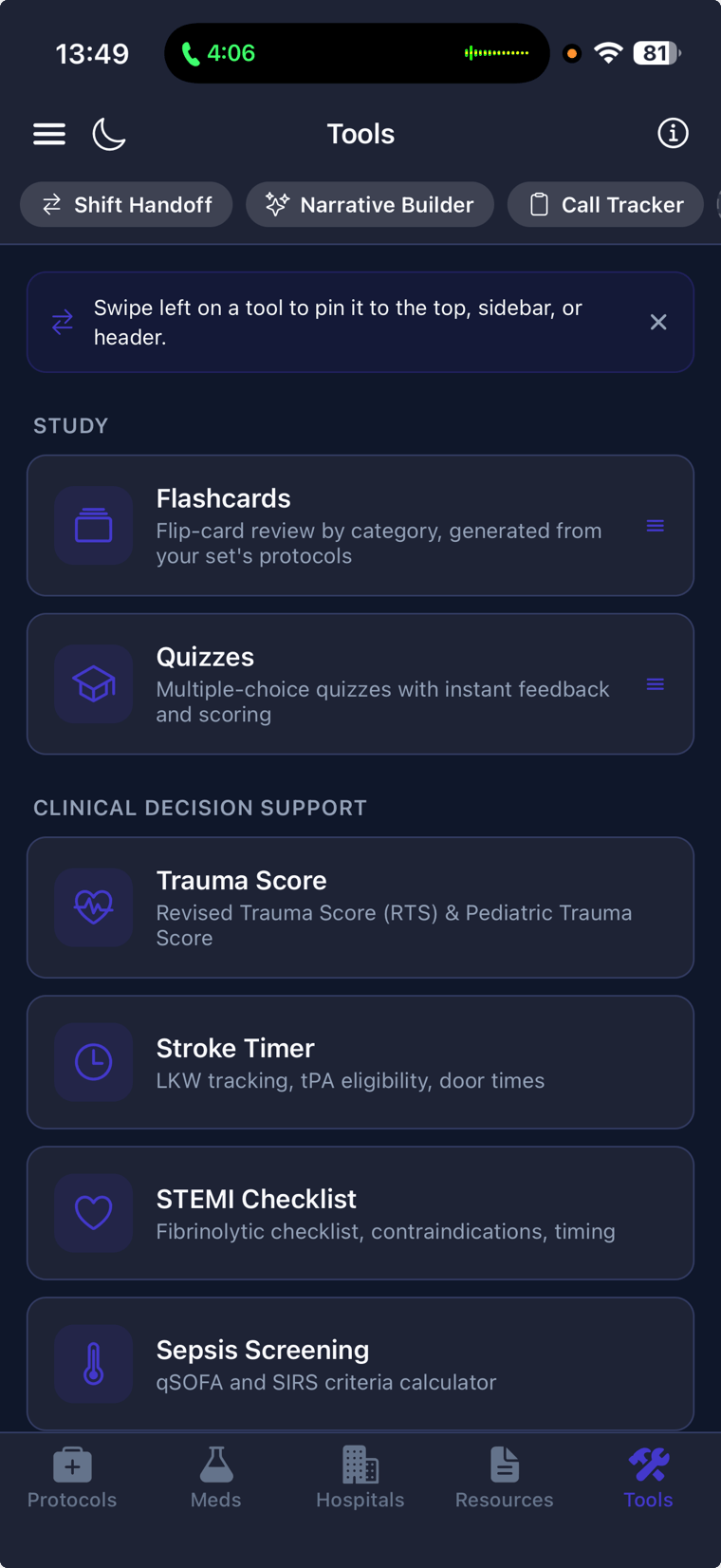
Pocket Protocols showing California's protocols, medications, and hospitals — searchable and fully offline.
What's covered in California
The protocol sets serving California right now.
Alameda County Protocols
Central California EMS Agency
Coastal Valleys EMS Agency (CVEMSA)
Contra Costa EMS
El Dorado County EMS
Imperial County EMS
Inland Counties EMS Agency (ICEMA)
Kern County EMS
San Diego County EMS Office
San Joaquin EMS Agency ALS
San Joaquin EMS Agency BLS
Santa Barbara County EMS Agency
Study tools for Alameda County Protocols
A few real flashcards and quiz questions from California's own protocols — the full set, plus a spaced-review deck, is in the app.
Flashcards
Adult ACS: assessment indications
Adult ACS-STEMI: ECG finding
BLS CPR: arrest recognition
Adult bradycardia: recognition
Adult arrest general: cause assessment
Adult asystole/PEA: initial resuscitation
Adult VF/pVT: defibrillator pad configuration
Adult refractory VF/pVT: definition
Quiz questions
An adult being assessed for ACS has had the initial 12-lead recorded. How should the ECG be managed during continued care?
- Delay the initial ECG until transport is complete
- ✓ Keep it continuously attached for serial ECGs if cardiac changes are detected
- Use the initial tracing as a reason to omit transport monitoring
- Detach it immediately after the initial tracing
The initial ECG has a STEMI-positive interpretation. What does Adult ACS-STEMI say about obtaining a right-sided 12-lead on scene?
- Complete both initial and second IVs on scene before transport
- Disregard the STEMI-positive interpretation until it is obtained
- ✓ Do not delay transport to obtain it after STEMI has been identified
- Always delay transport until it is obtained
Two rescuers are performing CPR on an adult without an advanced airway. Which compression-to-ventilation ratio matches the BLS CPR summary?
- 3:1
- 15:2
- ✓ 30:2
- Compressions must always stop until an advanced airway is placed
A dialysis patient has weakness and palpitations. Suspected hyperkalemia is being assessed. Which cardiac assessment is specified?
- Use a normal pulse as a reason to omit all cardiac monitoring
- Wait for hospital treatment before any cardiac assessment
- Treat symptoms without obtaining an ECG
- ✓ Cardiac monitor and 12-lead ECG
An unresponsive hypothermic patient is being assessed by a BLS provider. What pulse-check instruction applies before CPR?
- Require the patient to walk to assess circulation
- ✓ Take 30-45 seconds to try to find a pulse and avoid compressions if any signs of life are present
- Begin compressions despite definite signs of life
- Ignore pulse assessment because severe hypothermia always proves death
An adult has symptomatic bradycardia with poor perfusion. IV access or waiting for atropine effect would delay pacing. Which instruction applies?
- Always delay pacing until IV access succeeds
- Treat an ECG alone as a reason to ignore poor perfusion
- ✓ Do not delay pacing to start an IV or wait for atropine effect
- Always delay pacing until atropine takes effect
Sourced from California's EMS authority
Pocket Protocols brings California's EMS protocols into a faster, fully offline app.
- Field protocols page ↗
- Alameda County ↗
- Central California EMS Agency ↗
- Special Memorandums ↗
- Coastal Valleys EMS Agency (CVEMSA) ↗
- Treatment guidelines page ↗
- EMS Special Memos ↗
- EMS policies page ↗
- Policies & protocols page ↗
- Imperial County EMS Policy & Protocol Manual ↗
- Inland Counties EMS Agency (ICEMA) ↗
- Kern County EMS ↗
- San Diego County EMS Office ↗
- San Joaquin EMS Agency Policies & Protocols ↗
- Policy 533 compiled manual (PDF) ↗
California protocols — FAQ
Are California's EMS protocols available offline?
Are the protocols specific to my county in California?
Is Pocket Protocols official, or affiliated with California?
How do California protocol updates reach the app?
Carry California's protocols on every call.
Download Pocket Protocols and keep your county's complete protocol set in your pocket — online or off.