Connecticut EMS protocols,
in your pocket.
Offline, county-specific protocols for Connecticut EMS providers — searchable, with a full medication reference, hospital finder, and study tools built in.
Covering 8 counties in Connecticut · Protocols current as of June 5, 2026
See it in the field
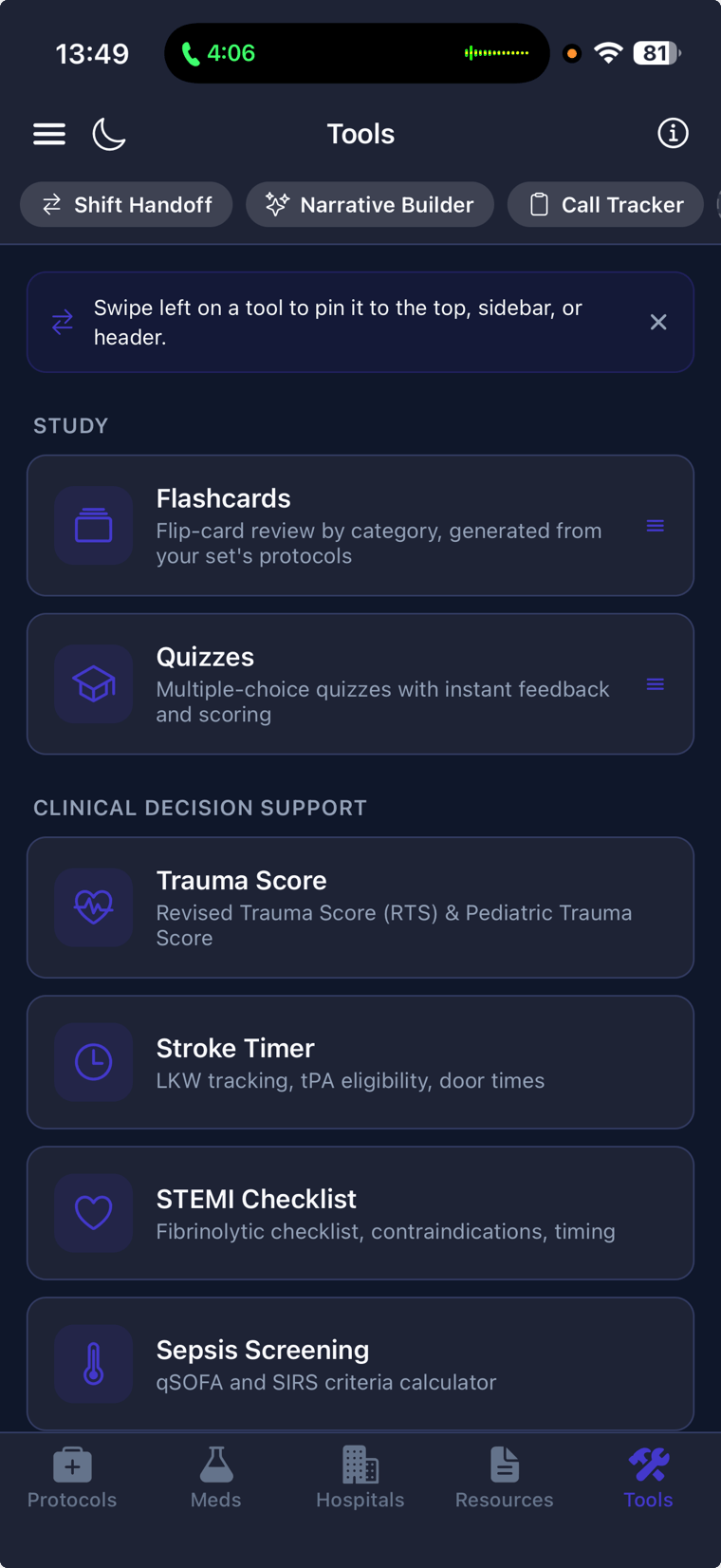
Pocket Protocols showing Connecticut's protocols, medications, and hospitals — searchable and fully offline.
What's covered in Connecticut
The protocol set serving Connecticut right now.
Connecticut Statewide Protocols
Study tools for Connecticut Statewide Protocols
A few real flashcards and quiz questions from Connecticut's own protocols — the full set, plus a spaced-review deck, is in the app.
Flashcards
IBW for a 5'8" male patient
Anatomical Landmarks for Percutaneous Cricothyrotomy
IBW for a 5'8" female patient
Correct Landmark for Pelvic Binder Placement
IBW for a 6'0" male patient
IBW for a 6'0" female patient
IBW difference between males and females at the same height
Tactile 'clicking' sign during Bougie insertion
Quiz questions
A paramedic is treating a hemodynamically unstable bradycardic adult patient. After administering the maximum dose of atropine with no improvement, what is the next appropriate intervention per Protocol 3.1A?
- Administer epinephrine infusion immediately without further steps
- ✓ Consider transcutaneous pacing
- Administer glucagon 5 mg IV/IO over 3–5 minutes
- Contact Direct Medical Oversight before taking any further action
An EMT is treating an adult patient in respiratory distress with a history of congestive heart failure. The patient's systolic BP is 118 mmHg. Which of the following interventions is within the EMT's standing orders?
- Administer nitroglycerin 0.4 mg SL from the unit's drug supply
- ✓ Facilitate administration of the patient's own nitroglycerin every 5 minutes
- Initiate IV/IO nitroglycerin at 50 micrograms/minute
- Apply nitroglycerin paste 1"–2" transdermally
You respond to a scene where a subject has been tased. Law enforcement has already removed the probes. The subject is now complaining of chest pain and palpitations. According to Protocol 6.18, what is the most appropriate action?
- Advise the patient that current literature does not support routine medical evaluation after Taser application and offer refusal paperwork.
- ✓ Activate EMS and initiate a full patient assessment, as chest pain and palpitations are listed indications for EMS activation.
- Transport the patient only if a 12-lead ECG shows abnormalities.
- Contact Direct Medical Oversight before initiating any assessment.
According to Protocol 6.23, what is the correct indication for initiating Double Sequential Defibrillation (DSD)?
- Ventricular fibrillation that recurs after successful conversion by standard defibrillation
- ✓ Ventricular fibrillation/tachycardia refractory to 3 consecutive shocks with no change in rhythm and a second defibrillator is available
- Any pulseless ventricular tachycardia that does not respond to the first defibrillation attempt
- Ventricular fibrillation persisting after 2 minutes of CPR regardless of number of shocks delivered
A paramedic is managing a cardiac arrest and is considering termination of resuscitation on standing order. What is the minimum duration of high-quality CPR required before termination can be considered?
- 10 minutes
- 15 minutes
- ✓ 20 minutes
- 30 minutes
According to the protocol, which ECG finding is characteristic of SEVERE (rather than moderate) hyperkalemia?
- Peaked T waves with QRS widening greater than 120 ms
- Increases in the PR interval with decreased P wave amplitude
- ✓ Very wide QRS complex (often >240 ms) with loss of P waves and possible sine wave pattern
- ST-segment elevation in the limb leads
Sourced from Connecticut's EMS authority
Pocket Protocols brings Connecticut's EMS protocols into a faster, fully offline app.
Connecticut protocols — FAQ
Are Connecticut's EMS protocols available offline?
Are the protocols specific to my county in Connecticut?
Is Pocket Protocols official, or affiliated with Connecticut?
How do Connecticut protocol updates reach the app?
Carry Connecticut's protocols on every call.
Download Pocket Protocols and keep your county's complete protocol set in your pocket — online or off.