Delaware EMS protocols,
in your pocket.
Offline, county-specific protocols for Delaware EMS providers — searchable, with a full medication reference, hospital finder, and study tools built in.
Protocols current as of October 1, 2026
See it in the field
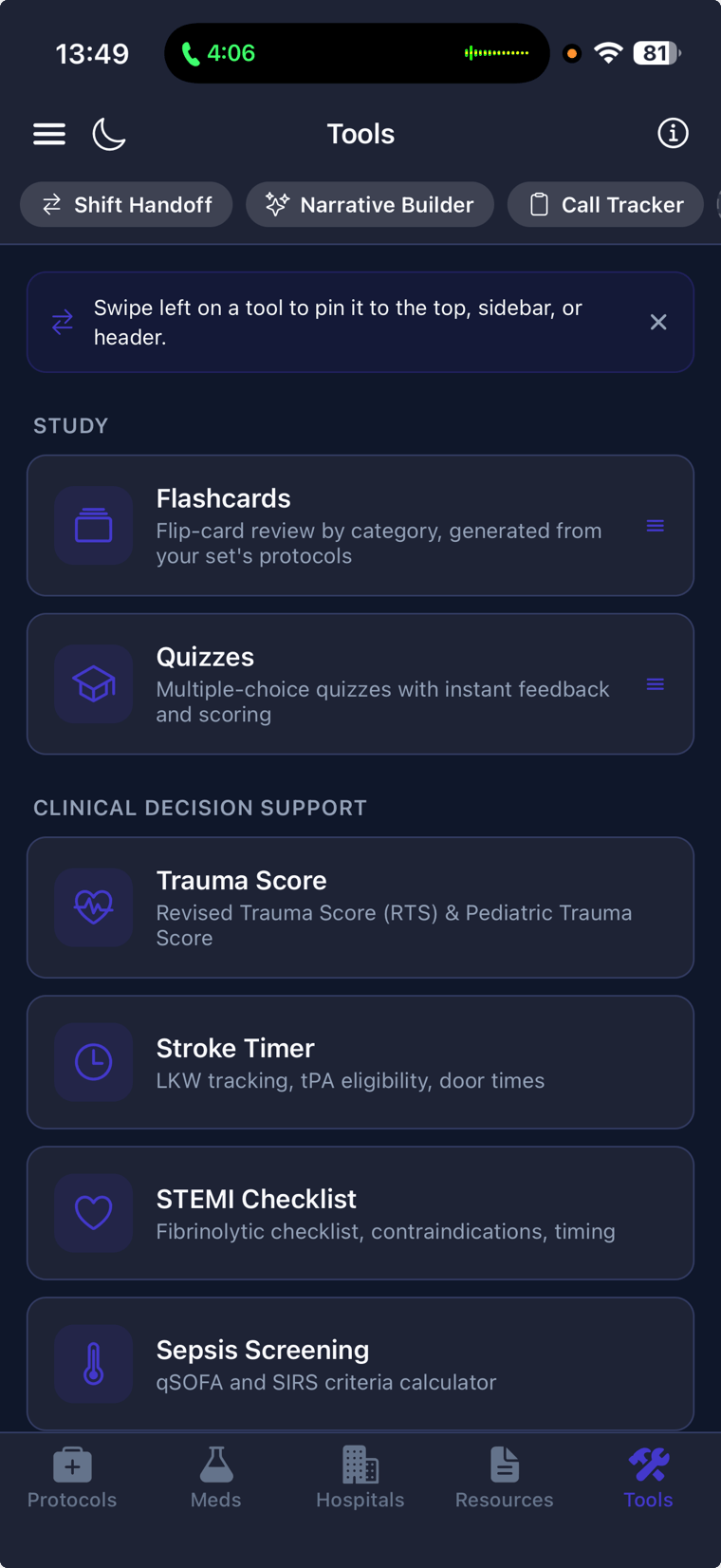
Pocket Protocols showing Delaware's protocols, medications, and hospitals — searchable and fully offline.


What's covered in Delaware
The protocol sets serving Delaware right now.
Delaware Advanced Life Support Protocols
Delaware Basic Life Support Protocols
Study tools for Delaware Advanced Life Support Protocols
A few real flashcards and quiz questions from Delaware's own protocols — the full set, plus a spaced-review deck, is in the app.
Flashcards
Indications for the Unstable Tachycardia protocol
Rhythm check interval and maximum pause duration during CPR
STEMI protocol: When must an IV be established BEFORE giving NTG?
Defibrillation energy setting and timing for VF/Pulseless VT
What is the indicated use of Valsalva maneuvers per the minimum skills list?
ACS: IV establishment requirement before NTG
EMS-witnessed VF/Pulseless VT: initial defibrillation approach
Passive oxygenation strategy for EID cardiac arrest patients
Quiz questions
You are treating a patient with suspected ACS who has a systolic BP of 108 mmHg. According to the protocol, what must be done BEFORE administering nitroglycerin?
- Administer 324 mg aspirin PO first, then give NTG without any further requirements
- ✓ Establish an IV prior to NTG administration
- Obtain a 12-lead ECG and transmit it to the receiving facility
- Contact Medical Control for permission to administer NTG
You are treating a stable patient with a wide complex tachycardia at a rate of 165 BPM, presumed to be ventricular tachycardia. The patient's systolic BP is 102 mmHg. Which intervention is indicated per protocol?
- Administer 6 mg adenosine IV rapidly
- ✓ Administer 150 mg amiodarone IV over 10 minutes
- Administer 0.25 mg/kg diltiazem IV over 2 minutes
- Perform synchronized cardioversion immediately
You arrive on scene to a 58-year-old male complaining of chest pain. Your 12-lead confirms STEMI. He tells you he took his own aspirin (325 mg) about 45 minutes ago. Per protocol, what should you do regarding aspirin administration?
- Administer 324 mg aspirin because it has been less than 60 minutes since his last dose
- ✓ Withhold aspirin because he has already taken an equivalent dose within the last 60 minutes
- Administer 162 mg aspirin as a half-dose since he recently self-administered
- Contact Medical Control before making any aspirin decision
You arrive on scene to find a patient with a narrow complex tachycardia at 170 BPM, a systolic BP of 78 mmHg, absent radial pulses bilaterally, and clinical signs of shock. You have IV access established. Per protocol, which of the following is an appropriate early action?
- ✓ Obtain a 12-lead EKG as soon as practicable
- Perform synchronized cardioversion at 360 joules immediately
- Administer 150 mg amiodarone IV over 10 minutes immediately
- Withhold treatment until medical control is contacted
According to the General Adult Cardiac Arrest Bundle of Care, how long should compressions be paused to check the cardiac rhythm, and what should be done prior to that pause?
- Pause for no more than 15 seconds; confirm IV access before the check
- ✓ Pause for no more than 5-10 seconds; charge the defibrillator before the check
- Pause for no more than 5-10 seconds; place an advanced airway before the check
- Pause for no more than 30 seconds; obtain a 12-lead ECG before the check
A cardiac arrest patient is receiving BVM ventilation that is working effectively. Your team has been on scene for 4 minutes. When should you consider placing an advanced airway according to this protocol?
- Immediately, to secure the airway before starting compressions
- After the first rhythm check, regardless of BVM effectiveness
- ✓ After at least three two-minute cycles of compressions and rhythm checks, vascular access is obtained, and medications are administered (generally at least six minutes)
- Only after 20 minutes of resuscitation have been completed on scene
Sourced from Delaware's EMS authority
Pocket Protocols brings Delaware's EMS protocols into a faster, fully offline app.
Delaware protocols — FAQ
Are Delaware's EMS protocols available offline?
Are the protocols specific to my county in Delaware?
Is Pocket Protocols official, or affiliated with Delaware?
How do Delaware protocol updates reach the app?
Carry Delaware's protocols on every call.
Download Pocket Protocols and keep your county's complete protocol set in your pocket — online or off.