District of Columbia EMS protocols,
in your pocket.
Offline, county-specific protocols for District of Columbia EMS providers — searchable, with a full medication reference, hospital finder, and study tools built in.
Covering 1 county in District of Columbia · Protocols current as of June 30, 2026
See it in the field
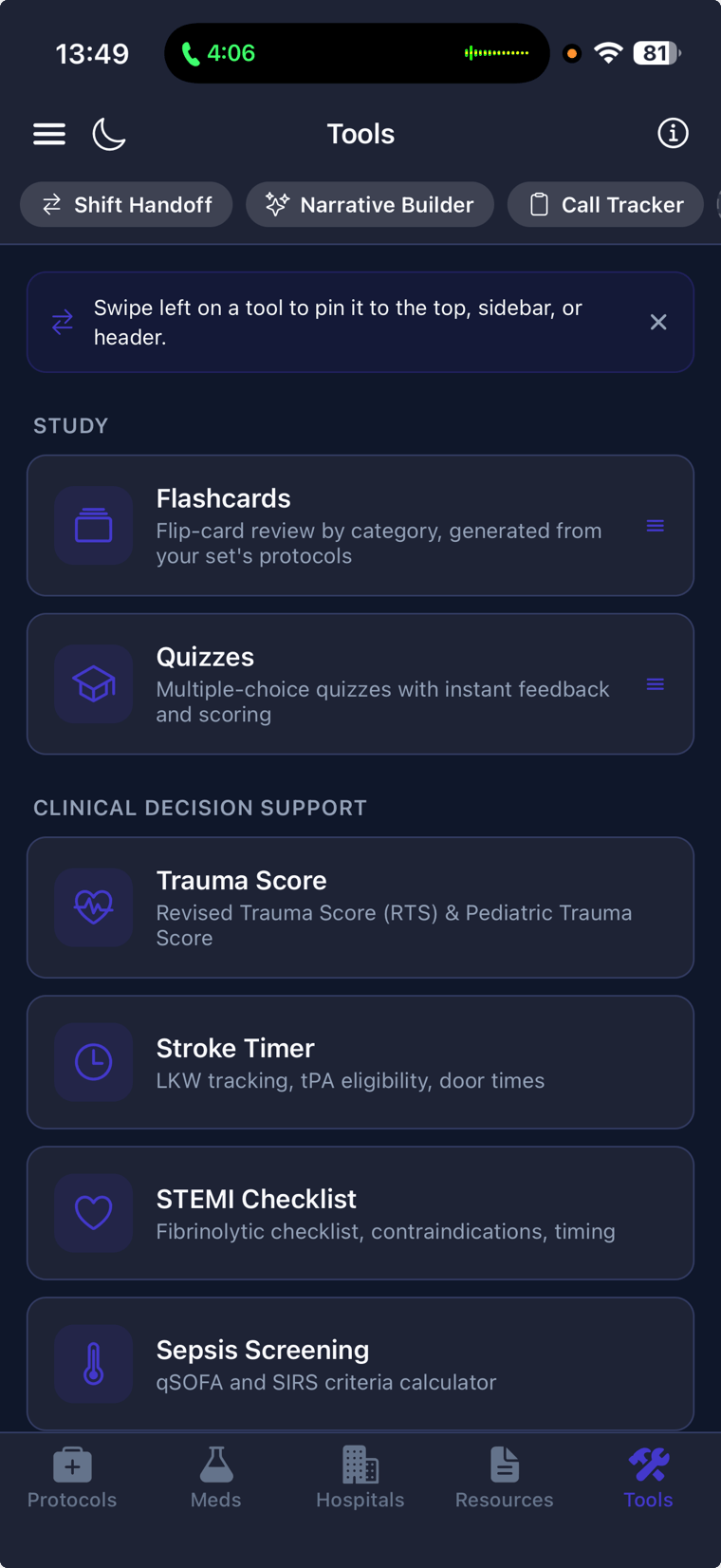
Pocket Protocols showing District of Columbia's protocols, medications, and hospitals — searchable and fully offline.
What's covered in District of Columbia
The protocol set serving District of Columbia right now.
District of Columbia EMS Manual
Study tools for District of Columbia EMS Manual
A few real flashcards and quiz questions from District of Columbia's own protocols — the full set, plus a spaced-review deck, is in the app.
Flashcards
Primary blast injury: which anatomical sites are most severely affected and why?
Three types of abdominal pain perception
Which fundal-height landmark is used to identify a pregnancy around 20 weeks in the trauma protocol?
Agonal breathing in OHCA: prevalence and significance
Defibrillation energy sequence for adults in VF/pVT (Shocks #1, #2, #3)
ROSC Transport Destination — Adult vs. Pediatric
Definition of Refractory VF/pVT
Wide Complex Tachycardia — Definition & EKG Criteria
Quiz questions
According to the September 2022 ECPR/ECMO checklist, which hospital and availability statement is correct?
- Georgetown University Hospital offers ECMO 24/7
- ✓ George Washington University Hospital (H8) offers ECMO Monday–Friday, 0800–1700; H13 offers ECMO 24/7
- H13 offers ECMO only Monday–Friday, 0700–1900
- Howard University Hospital offers ECMO only on weekends
According to the DC Fire and EMS Cardiac Arrest protocol, when a provider is uncertain whether a pulse is present, what action should be taken?
- Continue assessing for up to 30 seconds before starting compressions
- Start chest compressions immediately without checking for a pulse
- ✓ Promptly start compressions when a pulse is not definitely palpated
- Apply an AED first, then reassess for a pulse
You arrive on scene to find an adult patient in cardiac arrest. The monitor shows an organized rhythm with QRS complexes but no pulse is detected. According to the DC Fire and EMS PEA/Asystole Protocol, when should the first dose of epinephrine be administered?
- ✓ As soon as possible via IV/IO access
- After the second defibrillation attempt
- Only after 2 minutes of CPR have been completed
- After ROSC is confirmed and then lost again
According to the DC Fire and EMS ROSC protocol, where MUST all adult patients successfully resuscitated from a medical cardiac arrest be transported, regardless of initial rhythm or 12-lead EKG findings?
- The nearest emergency department
- ✓ A STEMI/ROSC receiving facility
- Children's National Hospital
- Any trauma center
You arrive at the scene of a 58-year-old male in cardiac arrest. Your monitor confirms VF. The monitor is NOT yet precharged. What is the correct immediate action per the DC FEMS VF/pVT protocol?
- Wait for the monitor to charge before resuming chest compressions
- Administer epinephrine 1 mg IV/IO immediately before defibrillating
- ✓ Resume chest compressions after the pulse check while charging the monitor/defibrillator
- Defibrillate immediately at 200 J, then resume CPR
According to the DC Fire and EMS protocol, when does the 30-minute ALS care clock officially START for the purpose of Termination of Resuscitation (TOR)?
- When the first EMS unit arrives on scene
- When the first chest compression is delivered by EMS
- ✓ When the monitor/defibrillator is both turned on AND attached to the patient
- When the ALS unit arrives and assumes care from BLS
Sourced from District of Columbia's EMS authority
Pocket Protocols brings District of Columbia's EMS protocols into a faster, fully offline app.
District of Columbia protocols — FAQ
Are District of Columbia's EMS protocols available offline?
Are the protocols specific to my county in District of Columbia?
Is Pocket Protocols official, or affiliated with District of Columbia?
How do District of Columbia protocol updates reach the app?
Carry District of Columbia's protocols on every call.
Download Pocket Protocols and keep your county's complete protocol set in your pocket — online or off.