Hawaii EMS protocols,
in your pocket.
Offline, county-specific protocols for Hawaii EMS providers — searchable, with a full medication reference, hospital finder, and study tools built in.
Covering 5 counties in Hawaii · Protocols current as of June 16, 2026
See it in the field
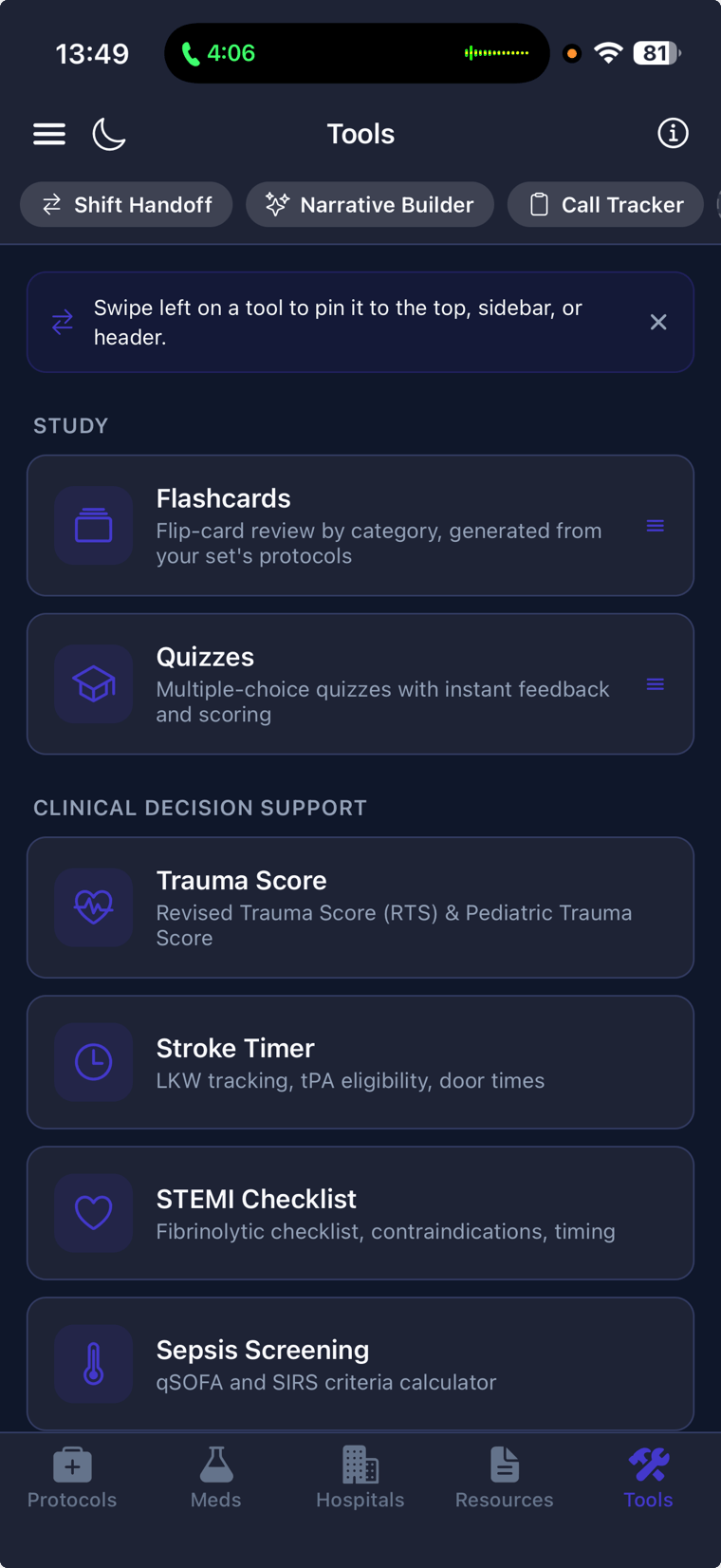
Pocket Protocols showing Hawaii's protocols, medications, and hospitals — searchable and fully offline.


What's covered in Hawaii
The protocol set serving Hawaii right now.
Hawaii Adult & Pediatric Standing Orders
Study tools for Hawaii Adult & Pediatric Standing Orders
A few real flashcards and quiz questions from Hawaii's own protocols — the full set, plus a spaced-review deck, is in the app.
Flashcards
Primary site for needle thoracostomy decompression
Shock: When to reduce IV/IO infusion rate to TKO
Maximum repeat doses of nitroglycerin for adult chest pain
HP-CPR
STEMI – Prehospital Transport Destination & Communication Requirement
STEMI Alert — prehospital criteria and transport decision
HP-CPR chest compression parameters
HP-CPR ventilation target during cardiac arrest
Quiz questions
According to the June 2025 Hawaii Standing Orders update, what is the correct aspirin dose for an adult chest pain patient without a history of allergic reaction?
- 81 mg
- 162 mg
- ✓ 325 mg
- 500 mg
A MICT arrives on scene to find a patient in cardiopulmonary arrest. Per the Hawaii MICT Standing Orders abbreviations, what does 'HP-CPR' stand for?
- Hospital-Performed Cardiopulmonary Resuscitation
- ✓ High Performance Cardiopulmonary Resuscitation
- Hands-Placed Cardiopulmonary Resuscitation
- High Priority Cardiopulmonary Resuscitation
A patient with chest pain suggestive of myocardial ischemia has received two doses of nitroglycerin 5 minutes apart. His BP is currently 104 mmHg systolic and pain continues. Per protocol, what is the next correct step?
- Withhold further NTG because the maximum of two doses has been reached
- ✓ Administer a third dose of NTG 0.4 mg sublingual since BP remains > 100 mmHg
- Contact the base station physician before giving any additional NTG
- Establish IV access before administering a third dose of NTG
A prehospital EKG on a 58-year-old male reveals ST-segment elevation in multiple leads, strongly suggesting a STEMI. The crew is capable of transmitting the EKG. According to the protocol, which action is REQUIRED?
- Transport to the nearest emergency department and notify them upon arrival.
- ✓ Transport to the nearest PCTA facility and communicate with the receiving physician; transmit EKG if capable.
- Contact the base station physician first and await orders before selecting a destination.
- Transport to The Queen's Medical Center Punchbowl as it is the only approved STEMI destination.
EMS arrives to find a 55-year-old male in cardiac arrest. Bystander CPR was in progress before arrival. The patient was NOT witnessed by EMS, his initial rhythm is PEA confirmed in two leads on a printed strip, he is > 18 years old, no defibrillation has been performed, an advanced airway is confirmed with digital waveform capnography, and after 22 minutes of ALS resuscitation there is no ROSC. The ETCO2 reads 8 mmHg. Which statement BEST describes whether this patient meets criteria for Termination of Resuscitation?
- He does not qualify because bystander CPR was initiated before EMS arrived
- He does not qualify because PEA is a shockable rhythm
- ✓ He meets ALL criteria for Termination of Resuscitation consideration
- He does not qualify because ETCO2 must be above 10 mmHg to terminate
You acquire a 12-lead ECG on a chest pain patient and identify significant ST elevations. According to the protocol, which of the following best describes the correct sequence of actions?
- Transport immediately to the nearest hospital and notify en route using the phrase 'STEMI Alert'
- ✓ Notify the receiving hospital using the phrase 'STEMI Alert' as soon as possible and transport to the closest appropriate hospital, preferably one with PCI capability
- Administer aspirin first, then notify the receiving hospital using the phrase 'Cardiac Alert'
- Contact the base station physician for orders before notifying the receiving hospital
Sourced from Hawaii's EMS authority
Pocket Protocols brings Hawaii's EMS protocols into a faster, fully offline app.
Hawaii protocols — FAQ
Are Hawaii's EMS protocols available offline?
Are the protocols specific to my county in Hawaii?
Is Pocket Protocols official, or affiliated with Hawaii?
How do Hawaii protocol updates reach the app?
Carry Hawaii's protocols on every call.
Download Pocket Protocols and keep your county's complete protocol set in your pocket — online or off.