Kentucky EMS protocols,
in your pocket.
Offline, county-specific protocols for Kentucky EMS providers — searchable, with a full medication reference, hospital finder, and study tools built in.
Covering 120 counties in Kentucky · Protocols current as of June 16, 2026
See it in the field
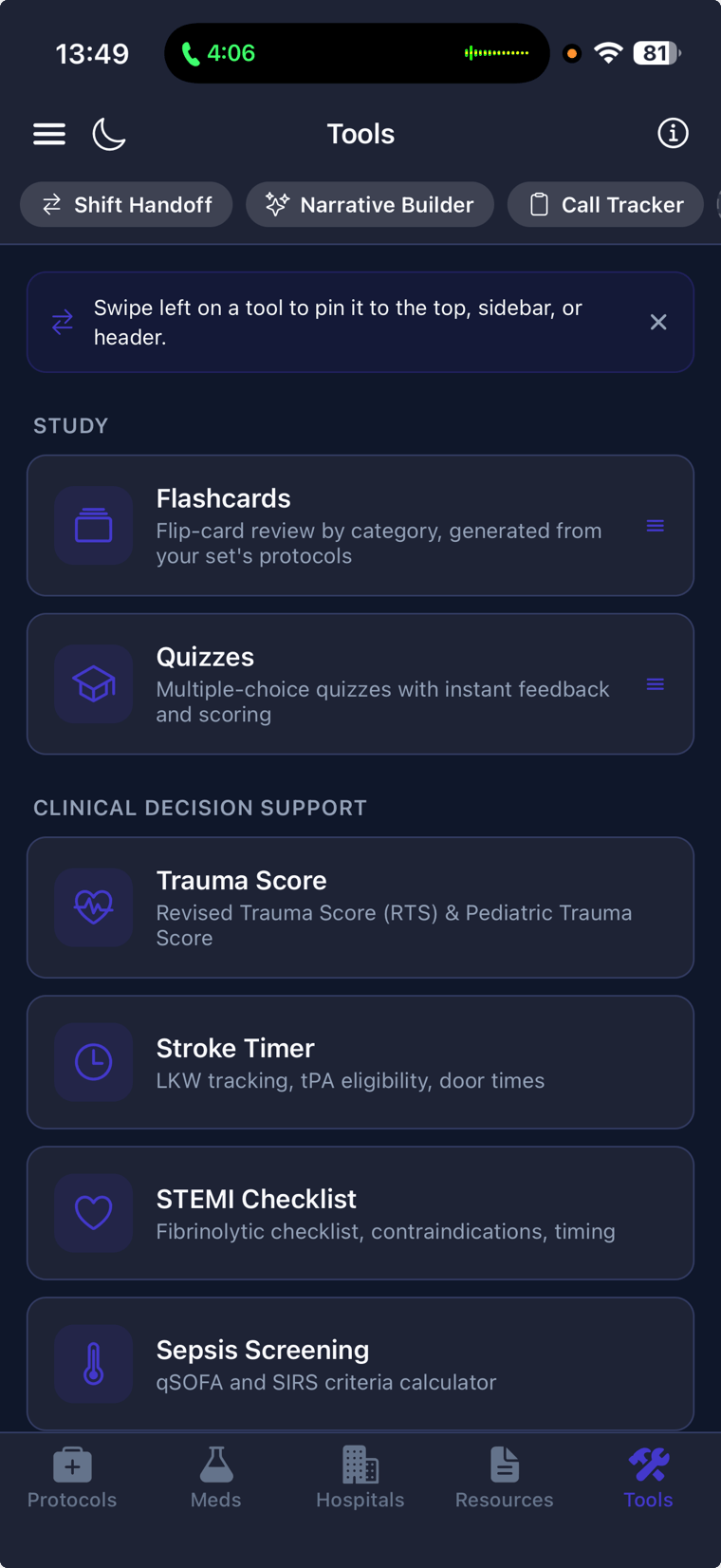
Pocket Protocols showing Kentucky's protocols, medications, and hospitals — searchable and fully offline.
What's covered in Kentucky
The protocol set serving Kentucky right now.
Kentucky Patient Care Guidelines
Study tools for Kentucky Patient Care Guidelines
A few real flashcards and quiz questions from Kentucky's own protocols — the full set, plus a spaced-review deck, is in the app.
Flashcards
Gastrostomy (G) tube vs. Jejunal (J) tube — what is the anatomical difference?
Anatomical zone where injuries may involve BOTH chest and abdomen
Colostomy: Type of stoma described in protocol
Patient Positioning and Landmark Identification for Surgical Cricothyrotomy
GCS Motor Response: Flexion to Pain vs. Extension to Pain
First step for any patient with chest pain or equivalent symptoms suggestive of ischemia
Ideal FMC-to-device time goal when EMS transports directly to a PCI-capable hospital
FMC-to-device time goal for STEMI patients initially transported to a non-PCI-capable hospital
Quiz questions
According to the KBEMS STEMI Destination Plan, what is the FIRST action EMS should take for a patient presenting with chest pain or equivalent symptoms suggestive of ischemia?
- Administer aspirin and obtain IV access
- ✓ Perform a STAT 12-lead EKG at the scene
- Immediately transport to the closest PCI-capable hospital
- Notify the receiving hospital of a possible STEMI
A STEMI patient has stable hemodynamics and airway, and a PCI-capable hospital is 40 minutes away by ground transport. What is the correct destination decision per the KBEMS STEMI Destination Plan?
- Transport to the closest non-PCI hospital and administer fibrinolytic therapy within 30 minutes
- Transport to the closest, most-appropriate facility regardless of PCI capability
- ✓ Transport to the closest PCI-capable hospital
- Consider fibrinolytic therapy and transport to the closest facility
You are preparing to establish an EJ IV on a conscious STEMI patient who has no peripheral IV access. What does the protocol specifically recommend regarding this situation?
- Proceed with EJ access, as STEMI is not listed as an exclusion criterion.
- Obtain bilateral EJ access simultaneously to maximize flow rates.
- ✓ Use caution because a neck hematoma may complicate care, and consider IO as an alternative.
- Contact medical control before making any attempt at EJ access in a STEMI patient.
A confirmed STEMI patient is hemodynamically stable, but the nearest PCI-capable hospital is 60 minutes away by ground or air. The patient has no contraindications to fibrinolytic therapy. According to the KBEMS STEMI Destination Plan, what should be done?
- Transport to the closest PCI-capable hospital regardless of travel time
- ✓ Transport to the closest, most-appropriate facility and consider fibrinolytic therapy within 30 minutes
- Administer fibrinolytic therapy on scene before transport
- Wait on scene for air transport to become available
According to the KBEMS STEMI Destination Plan, what is the ideal system goal for First Medical Contact (FMC)-to-device time when EMS transports a STEMI patient directly to a PCI-capable hospital?
- Less than 60 minutes
- ✓ Less than 90 minutes
- Less than 120 minutes
- Less than 180 minutes
You arrive on scene with a child with known congenital cardiac disease who appears cyanotic. You attempt to assess perfusion but cannot find a pulse in the right arm. According to the protocol, the most appropriate interpretation of this finding is:
- This indicates cardiac arrest; begin CPR immediately.
- ✓ Cardiac patients may have absent pulses in some limbs and may be chronically hypoxic or have hypoxic spells.
- The absent pulse confirms severe hemorrhagic shock and IV fluid resuscitation should begin.
- Absent pulses are abnormal in cardiac patients and indicate a new acute occlusion requiring immediate intervention.
Sourced from Kentucky's EMS authority
Pocket Protocols brings Kentucky's EMS protocols into a faster, fully offline app.
Kentucky protocols — FAQ
Are Kentucky's EMS protocols available offline?
Are the protocols specific to my county in Kentucky?
Is Pocket Protocols official, or affiliated with Kentucky?
How do Kentucky protocol updates reach the app?
Carry Kentucky's protocols on every call.
Download Pocket Protocols and keep your county's complete protocol set in your pocket — online or off.