Maine EMS protocols,
in your pocket.
Offline, county-specific protocols for Maine EMS providers — searchable, with a full medication reference, hospital finder, and study tools built in.
Covering 16 counties in Maine · Protocols current as of June 17, 2026
See it in the field
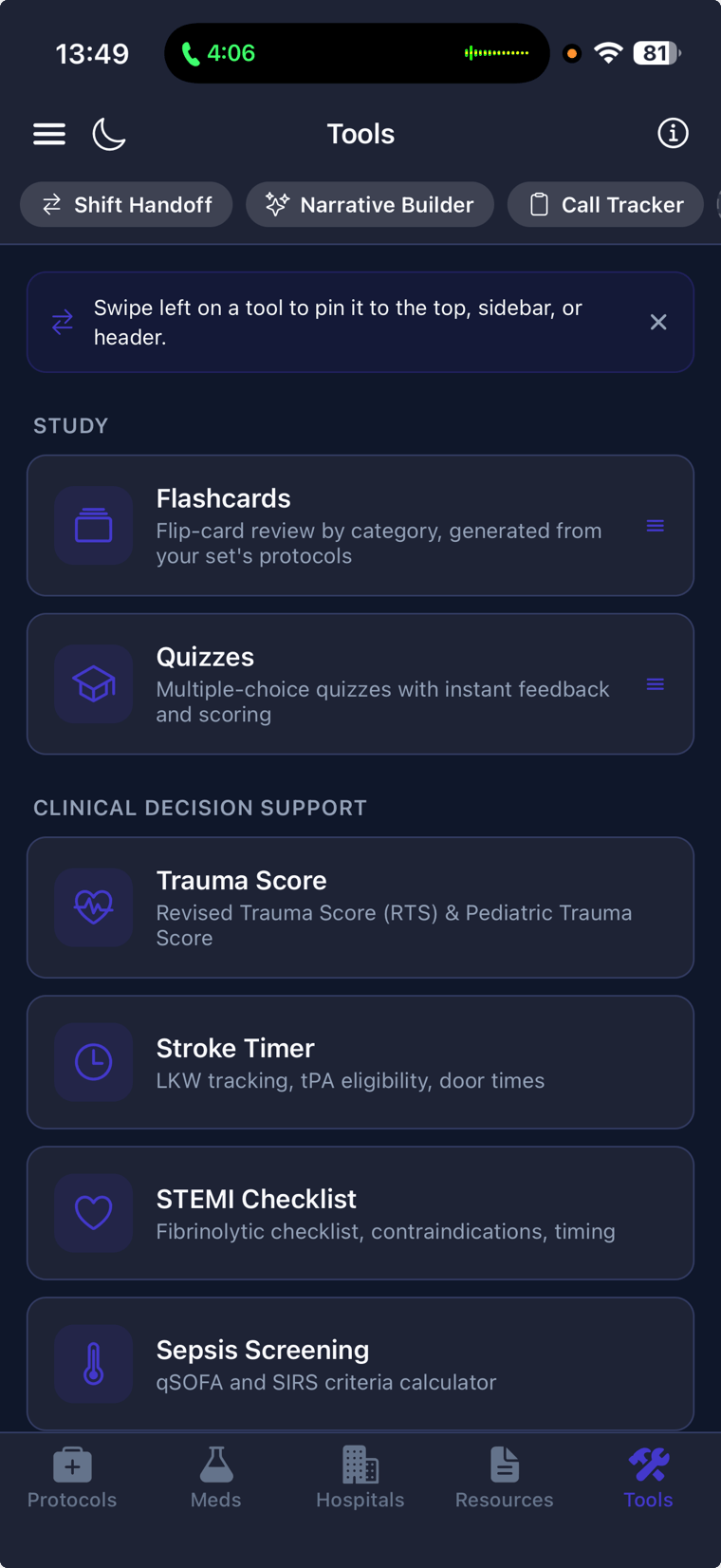
Pocket Protocols showing Maine's protocols, medications, and hospitals — searchable and fully offline.
What's covered in Maine
The protocol set serving Maine right now.
Maine Prehospital Treatment Protocols
Study tools for Maine Prehospital Treatment Protocols
A few real flashcards and quiz questions from Maine's own protocols — the full set, plus a spaced-review deck, is in the app.
Flashcards
Anatomical location of the canine cricothyroid membrane
Why should bilateral chest decompression be considered in a K9?
How many ribs does a canine have, and why is this clinically relevant?
What are the three categories a chest pain patient may fall into per the Chest Pain - General protocol?
Which patients require prehospital 12-lead ECG acquisition?
Refractory VF/VT — definition
Fibrinolytic Checklist: Initial therapies for suspected cardiac chest pain
Adult Bradycardia: Definition
Quiz questions
According to the Chest Pain - General protocol, all patients presenting with chest pain should be transported for emergency medical evaluation because:
- EMS clinicians can reliably rule out cardiac causes in the field with available tools.
- ✓ It is difficult with the tools available to EMS clinicians to completely rule out a cardiac cause of chest pain.
- All chest pain is cardiac in origin until proven otherwise.
- Transport is only required if the patient has a prior cardiac history.
According to the protocol, in which of the following patient presentations should a 12-lead ECG be acquired?
- Chest pain only
- ✓ Chest pain, syncope, or shortness of breath
- Chest pain and shortness of breath only
- Cardiac arrest only
According to the Adult Refractory VF/VT protocol, dual-sequential external defibrillation (DSD) should be considered after how many unsuccessful defibrillation attempts?
- After 1 unsuccessful attempt
- After 2 unsuccessful attempts
- ✓ After 3 unsuccessful attempts
- After 5 unsuccessful attempts
According to the Cardiac Arrest Overview protocol, what is the target compression rate when using a CPR feedback device or metronome?
- 80-100 compressions per minute
- ✓ 100-120 compressions per minute
- 120-140 compressions per minute
- At least 60 compressions per minute
According to the Chest Pain Fibrinolytic Checklist, which blood pressure finding would raise a concern as a potential contraindication to fibrinolytic therapy?
- Systolic BP greater than 160 mmHg OR diastolic BP greater than 90 mmHg
- ✓ Systolic BP greater than 180 mmHg OR diastolic BP greater than 100 mmHg
- Systolic BP greater than 200 mmHg OR diastolic BP greater than 110 mmHg
- Systolic BP greater than 140 mmHg OR diastolic BP greater than 80 mmHg
A BLS crew has been working a cardiac arrest patient with unknown downtime. They find the patient to be cool to the touch (not from exposure), with no audible heart sounds and fixed/dilated pupils. No bystander CPR was performed. According to the protocol, what is the appropriate action?
- Begin resuscitation immediately and transport to the nearest ED
- ✓ Withhold resuscitation, as the criteria for doing so have been met
- Begin resuscitation and contact OLMC for guidance
- Withhold resuscitation only if rigor mortis is also present
Sourced from Maine's EMS authority
Pocket Protocols brings Maine's EMS protocols into a faster, fully offline app.
Maine protocols — FAQ
Are Maine's EMS protocols available offline?
Are the protocols specific to my county in Maine?
Is Pocket Protocols official, or affiliated with Maine?
How do Maine protocol updates reach the app?
Carry Maine's protocols on every call.
Download Pocket Protocols and keep your county's complete protocol set in your pocket — online or off.