Live in Manitoba
Manitoba EMS protocols,
Manitoba EMS protocols,
in your pocket.
Offline, county-specific protocols for Manitoba EMS providers — searchable, with a full medication reference, hospital finder, and study tools built in.
Protocols current as of June 19, 2026
See it in the field
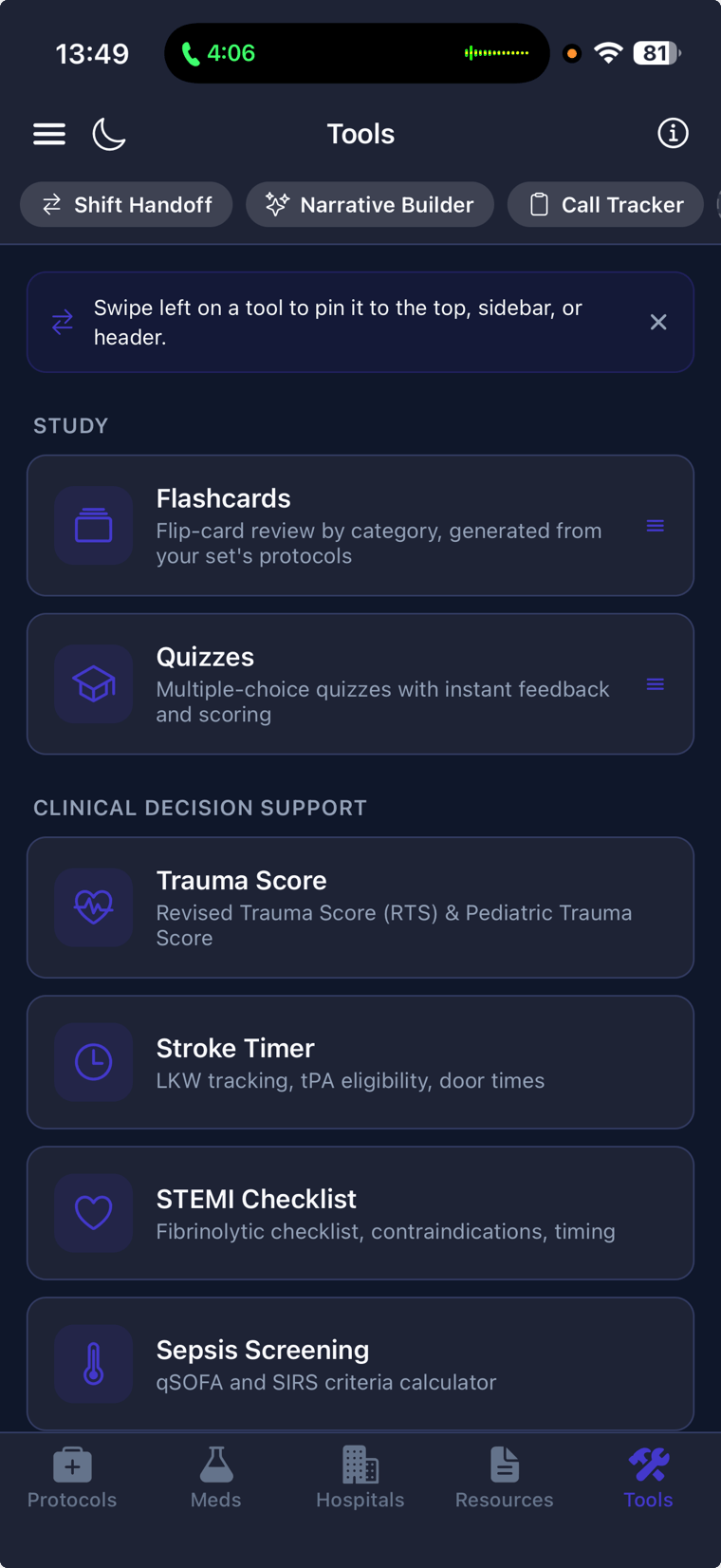
Pocket Protocols showing Manitoba's protocols, medications, and hospitals — searchable and fully offline.
What's covered in Manitoba
The protocol set serving Manitoba right now.
Shared Health EMS
Release Date: 2026-04-14 ↗
PDF document
701
Flashcards
371
Quiz questions
49
Medications
38
Resources
Study tools for Shared Health EMS
A few real flashcards and quiz questions from Manitoba's own protocols — the full set, plus a spaced-review deck, is in the app.
Flashcards
AAA Definition (anatomical)
An abdominal aortic aneurysm (AAA) is defined as an infrarenal aorta with a diameter greater than 3.0 centimeters. The aneurysm expands at approximately one-third of a centimeter per year, and the risk of spontaneous rupture increases significantly once the diameter reaches 5 cm.
Spinal injury distribution by region: cervical, thoracic, and thoracolumbar
The cervical spine accounts for approximately 50–60% of spinal injuries due to its mobility and exposure. The thoracic spine accounts for 10–15%, protected by its rigidity and the rib cage. The thoracolumbar junction accounts for 15–20%, as it acts as a fulcrum between the rigid thoracic and flexible lumbar regions.
Target SpO₂ range in post-ROSC care
The protocol targets an SpO₂ of 92–98% in post-ROSC patients. Over-oxygenation beyond this range may impair neurological recovery and should be actively avoided.
Adult defibrillation energy sequence (C02.1)
The protocol requires escalating energy levels: 120 J for the first shock, 150 J for the second, and 200 J for the third and all subsequent shocks. If uncertain of the correct level, do not delay — defibrillate at the highest available level. If a dysrhythmia recurs after initial termination, resume at the last successful energy level and escalate as needed.
C01 Indication: When is the Basic Cardiac Arrest protocol used?
This protocol is used for cardiac arrest due to nontraumatic causes. It applies to EMR-level providers only, for all ages. Trauma arrest is managed under F02.1, and providers with PCP scope refer to C02.
C05.1 Adult Bradycardia — Indication for Treatment
This protocol applies to a sustained heart rate less than 60 beats per minute that is causing instability in an adult (18 years and older). If the bradycardia is without a pulse, refer to C01 or C02.1 instead.
Signs & symptoms of unstable tachycardia (adult)
An unstable tachycardia in an adult presents with one or more of: acutely altered level of consciousness (LOC), hypotension/hypoperfusion/shock, chest pain or discomfort suggestive of myocardial ischemia, or acute decompensated heart failure/acute cardiogenic pulmonary edema. Treatment should NOT be delayed when any of these signs are present.
Signs and symptoms of an unstable tachycardia (adult)
An unstable tachycardia in an adult presents with one or more of: acutely altered level of consciousness, hypotension/hypoperfusion/shock, chest pain or discomfort suggestive of myocardial ischemia, or acute decompensated heart failure/acute cardiogenic pulmonary edema. Treatment should not be delayed when these signs are present.
Quiz questions
A PCP responds to a patient in PSVT that is refractory to vagal maneuvers. Which medication and route is within the PCP's scope of practice to administer for this indication?
- Adenosine via IV
- Diltiazem via IV
- Amiodarone via IO
- ✓ Adenosine is not within PCP scope for PSVT
A paramedic is treating a STEMI patient who is located 2 hours and 20 minutes from St. Boniface Hospital (SBH). After contacting VECTRS and conferencing in the STEMI physician, what is the most likely course of action per protocol?
- The STEMI physician will authorize direct transport to SBH regardless of distance.
- ✓ The STEMI physician may direct the paramedic to an alternate location for initial thrombolysis, followed by urgent secondary transport to SBH.
- The paramedic should transport to the nearest ED without contacting VECTRS further.
- VECTRS will activate the stroke team at HSC as a precautionary measure.
You arrive on scene to find a 72-year-old male on beta blockers with a heart rate of 48 bpm. He is alert and oriented with a BP of 118/76 mmHg and no chest pain. According to protocol C05.1, what is the most appropriate next step?
- Administer atropine immediately
- Begin transcutaneous pacing (TCP)
- ✓ Monitor the patient without intervention
- Initiate an epinephrine infusion
You are an ICP responding to an adult cardiac arrest. The patient is in shock-refractory VF. Your patient has a known history of end-stage renal disease (ESRD). According to protocol C02.1, what is your FIRST pharmacological priority?
- Administer amiodarone as the first-line antidysrhythmic
- Administer lidocaine due to suspected sodium channel blockade
- ✓ Treat for hyperkalemia, as it takes precedence over antidysrhythmic administration
- Administer sodium bicarbonate to correct metabolic acidosis
A patient achieves ROSC after a prolonged cardiac arrest. You are managing ventilation with a BVM. According to the C03 protocol, what are the target SpO₂ and EtCO₂ ranges you should maintain?
- SpO₂ = 94–100% and EtCO₂ = 30–40 mmHg
- ✓ SpO₂ = 92–98% and EtCO₂ = 35–45 mmHg
- SpO₂ = 98–100% and EtCO₂ = 25–35 mmHg
- SpO₂ = 90–95% and EtCO₂ = 40–50 mmHg
You are a PCP responding to a 58-year-old male with a heart rate of 178 bpm, altered level of consciousness, and hypotension. After identifying a non-sinus tachycardia on the ECG, what is the most appropriate next step according to protocol C06.1?
- Attempt vagal maneuvers before any further intervention
- Administer adenosine immediately
- ✓ Obtain the ECG but do not delay treatment — the ICP should perform cardioversion
- Administer metoprolol or diltiazem for rate control
Sourced from Manitoba's EMS authority
Pocket Protocols brings Manitoba's EMS protocols into a faster, fully offline app.
Manitoba protocols — FAQ
Are Manitoba's EMS protocols available offline?
Yes. Download the protocol set for your area once and every protocol, medication, and hospital is available with no signal — built for basements, rural calls, and dead zones.
Are the protocols specific to my county in Manitoba?
Pocket Protocols covers selected areas in Manitoba today, not the whole state. Protocol sets are scoped by county, so a provider in a covered county gets exactly the set that governs where they respond, and you can add more than one if you work across areas. Other counties are added as their EMS authorities come on board.
Is Pocket Protocols official, or affiliated with Manitoba?
No — Pocket Protocols is an independent app and isn't affiliated with or endorsed by any EMS authority. We bring Manitoba's protocols into a faster, fully offline app and link the authority's own source for every set.
How do Manitoba protocol updates reach the app?
When the EMS authority publishes a new version and it goes live in Pocket Protocols, the app refreshes automatically — crews are never working from a stale copy. We monitor official sources for changes every day.
Carry Manitoba's protocols on every call.
Download Pocket Protocols and keep your county's complete protocol set in your pocket — online or off.