Maryland EMS protocols,
in your pocket.
Offline, county-specific protocols for Maryland EMS providers — searchable, with a full medication reference, hospital finder, and study tools built in.
Covering 24 counties in Maryland · Protocols current as of September 23, 2026
See it in the field
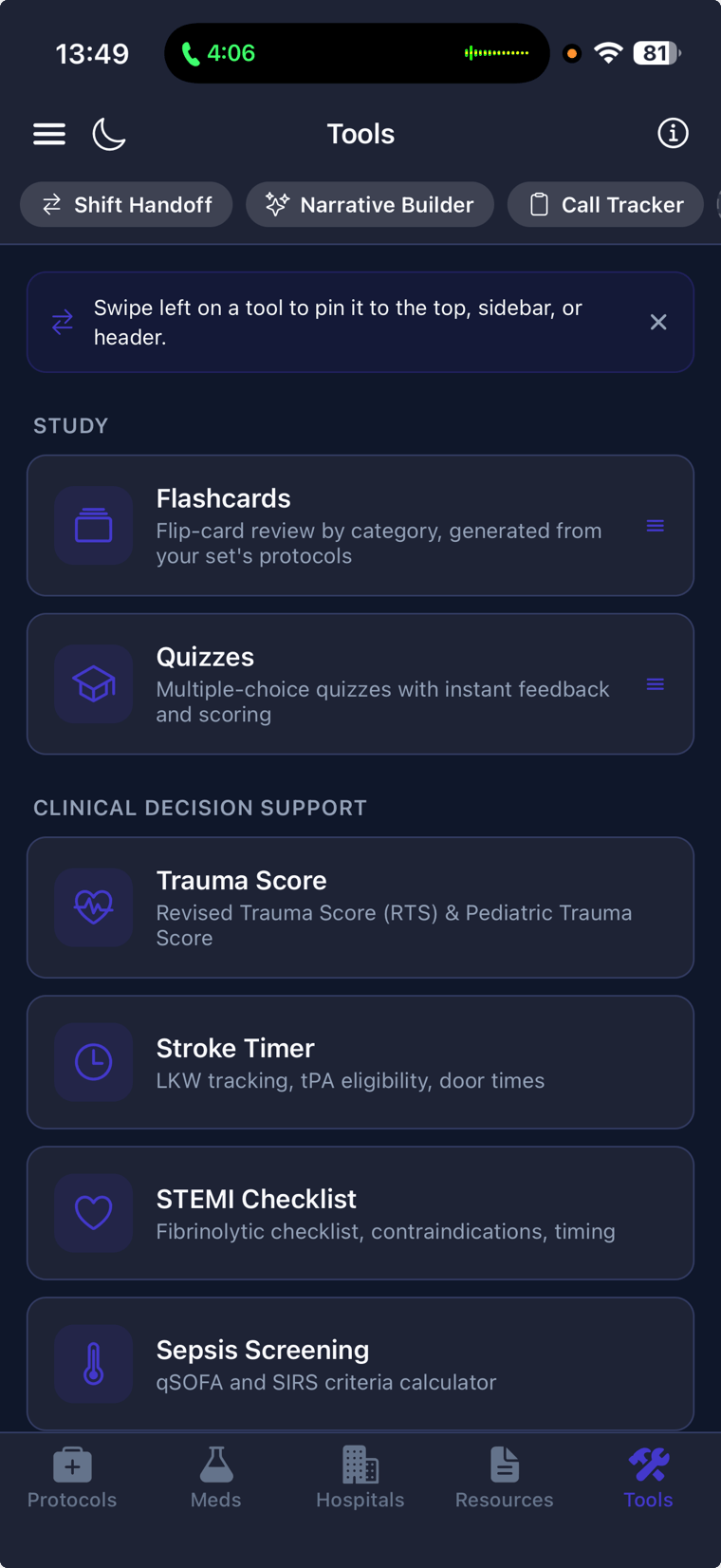
Pocket Protocols showing Maryland's protocols, medications, and hospitals — searchable and fully offline.
What's covered in Maryland
The protocol set serving Maryland right now.
The Maryland Medical Protocols for Emergency Medical Services
Study tools for The Maryland Medical Protocols for Emergency Medical Services
A few real flashcards and quiz questions from Maryland's own protocols — the full set, plus a spaced-review deck, is in the app.
Flashcards
Laryngectomy — airway management implication
BLS Adult Cardiac Arrest: Initial actions when no pulse is found
Exclusions to Termination of Resuscitation (TOR) — both adult and pediatric
ICD Malfunction: What TWO criteria must BOTH be met to activate this protocol?
Esmolol (Brevibloc) – Indication in Cardiac Arrest
mCPR device contraindications
BLS Adult Cardiac Arrest: Action when AED detects a NON-shockable rhythm
ETCO2 threshold for permitting TOR in adult medical arrest
Quiz questions
When initiating transcutaneous pacing (TCP) in an adult bradycardia patient, what is the correct approach to setting the current (m.a.)?
- Start at 200 m.a. and titrate down until capture is lost
- ✓ Start as low as possible and gradually increase until a palpable pulse confirms capture, up to 200 m.a. maximum
- Start at 100 m.a. and hold steady regardless of palpable pulse
- Start at 50 m.a. and increase in 50 m.a. increments every 2 minutes
A BLS crew arrives on scene to find an unresponsive adult who is not breathing. After checking for a pulse and finding none, what are the FIRST two actions the BLS crew should take simultaneously according to the Adult BLS Emergency Cardiac Care Algorithm?
- Administer 100% oxygen and obtain vital signs
- ✓ Begin HPCPR and attach an AED as soon as possible
- Support ventilation and call for ALS transport
- Analyze the cardiac rhythm and defibrillate immediately
A BLS crew arrives on scene to find a 58-year-old male in cardiac arrest with a medical etiology. Per protocol, what is the minimum on-scene resuscitation requirement before transport may be considered?
- Three doses of epinephrine administered by ALS
- ✓ Five two-minute cycles of chest compressions and rhythm interpretation
- Two shocks delivered and one dose of epinephrine
- Placement of a mechanical CPR device and advanced airway
You arrive on scene to find a patient with a valid MOLST Option A-1 form who is in respiratory distress but still has a palpable pulse and spontaneous respirations. Which of the following interventions is MOST appropriate?
- Provide supportive care only, including oxygen via nasal cannula, but withhold intubation and cardiac monitoring
- ✓ Provide the full scope of interventions including intubation, CPAP/BiPAP, cardiac monitoring, cardioversion, and medications
- Provide comprehensive care excluding intubation, as intubation is never permitted under any MOLST option
- Withhold all treatment and contact medical direction before initiating any interventions
You are on scene with a 45-year-old male in cardiac arrest from a medical cause. He does not meet Pronouncement of Death on Arrival (PDOA) criteria, is not pregnant, and has no signs of hypothermia. After completing the minimum required cycles of HPCPR without ROSC, the monitor shows PEA with an ETCO2 of 12 mmHg. According to the Adult TOR – Medical Arrest protocol, what is the appropriate next action?
- Continue resuscitation and reevaluate at the next rhythm check, as PEA never qualifies for TOR
- Immediately transport to the nearest emergency department
- ✓ May terminate resuscitation, as the rhythm is PEA with ETCO2 less than 15 mmHg after the minimum required HPCPR cycles
- Terminate resuscitation only if the rhythm converts to asystole
You respond to a patient with a known ICD who has received 4 shocks. You witness an inappropriate shock in an alert patient who is in atrial fibrillation with rapid ventricular rate. Which intervention should the ALS provider perform to stop the inappropriate shocks?
- Administer midazolam 0.1 mg/kg IV immediately and monitor
- ✓ Place a donut magnet directly over the device and tape it firmly in place
- Apply the AED pads and override the ICD manually
- Perform synchronized cardioversion using the manual defibrillator
Sourced from Maryland's EMS authority
Pocket Protocols brings Maryland's EMS protocols into a faster, fully offline app.
Maryland protocols — FAQ
Are Maryland's EMS protocols available offline?
Are the protocols specific to my county in Maryland?
Is Pocket Protocols official, or affiliated with Maryland?
How do Maryland protocol updates reach the app?
Carry Maryland's protocols on every call.
Download Pocket Protocols and keep your county's complete protocol set in your pocket — online or off.