Michigan EMS protocols,
in your pocket.
Offline, county-specific protocols for Michigan EMS providers — searchable, with a full medication reference, hospital finder, and study tools built in.
Covering 83 counties in Michigan · Protocols current as of June 17, 2026
See it in the field
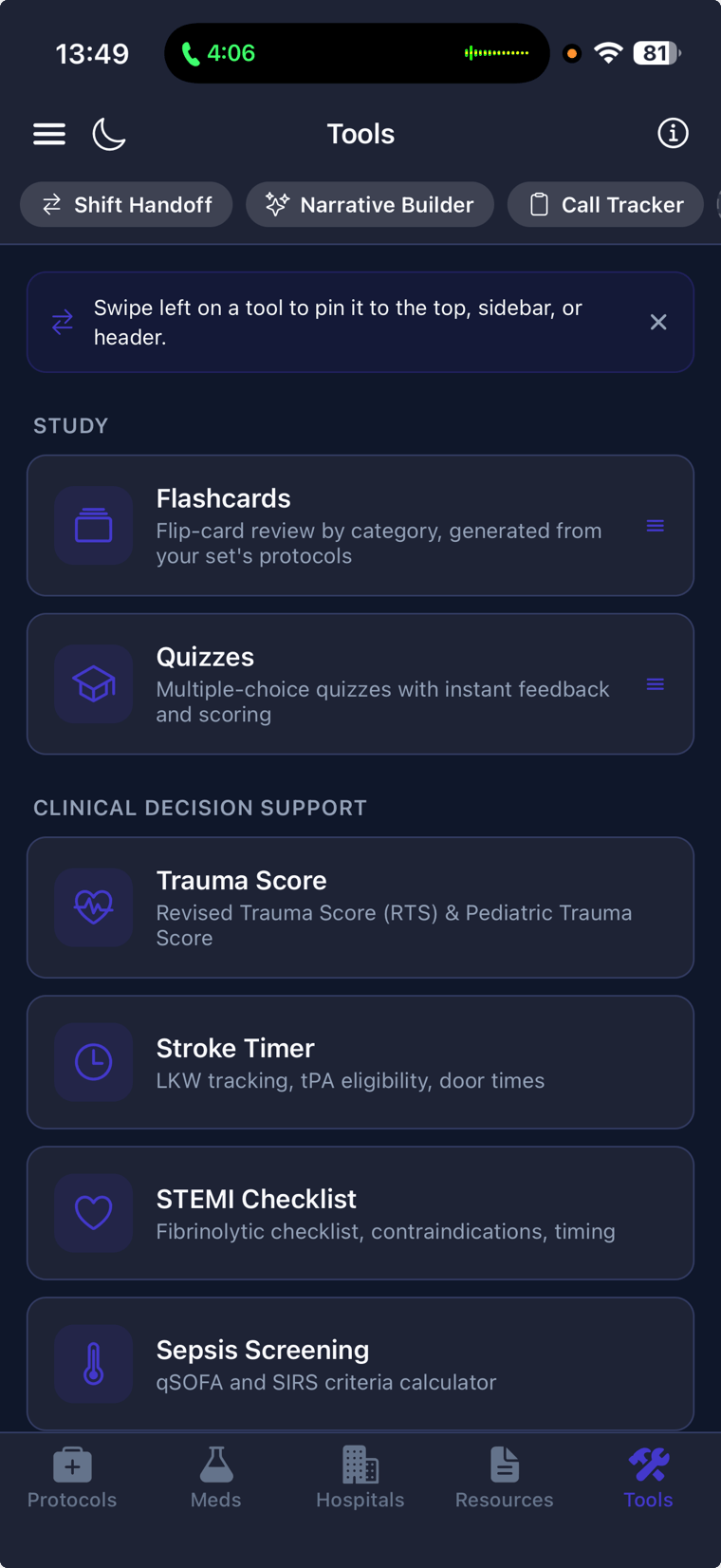
Pocket Protocols showing Michigan's protocols, medications, and hospitals — searchable and fully offline.
What's covered in Michigan
The protocol set serving Michigan right now.
Michigan Statewide Protocols
Study tools for Michigan Statewide Protocols
A few real flashcards and quiz questions from Michigan's own protocols — the full set, plus a spaced-review deck, is in the app.
Flashcards
Serious symptomatic bradycardia: definition and treatment goal
Tachycardia protocol activation threshold
ROSC scene stabilization time before transport
Signs and symptoms of an UNSTABLE tachycardia patient
Transcutaneous pacing (TCP): when is it the treatment of CHOICE?
ROSC hypotension definition and initial treatment
Pediatric defibrillation energy — initial and subsequent doses
Abdominal Pain (Non-traumatic): When and how should a 12-Lead ECG be considered?
Quiz questions
You are treating an adult cardiac arrest patient and have just successfully placed a supraglottic airway. According to the protocol, how should ventilations be delivered and at what rate?
- Synchronously with compressions at a ratio of 30:2
- ✓ Asynchronously at 10 breaths per minute (1 breath every 6 seconds)
- Asynchronously at 12 breaths per minute (1 breath every 5 seconds)
- Synchronously at 8 breaths per minute during compression pauses
After achieving ROSC in a medical cardiac arrest, how long should a patient be stabilized on scene before transport?
- Immediately load and go without delay
- Two to three minutes
- ✓ Five to ten minutes
- Fifteen to twenty minutes
You are treating a 68-year-old male in respiratory distress with crackles bilaterally and a SBP of 130 mmHg. He denies taking any erectile dysfunction medications. IV access has NOT yet been established. Which of the following is the correct nitroglycerin action per protocol?
- Withhold nitroglycerin until IV access is established
- ✓ Administer nitroglycerin 0.4 mg SL, up to a maximum of 3 doses
- Administer nitroglycerin 0.4 mg SL and repeat every 3-5 minutes as long as SBP remains above 100 mmHg
- Contact medical control before administering any nitroglycerin
You are treating a 58-year-old male complaining of chest pain. He tells you he took sildenafil (Viagra) 36 hours ago. Which of the following actions is most appropriate regarding nitroglycerin?
- Administer nitroglycerin 0.4 mg SL as normal, since 36 hours have passed.
- ✓ Do NOT administer or assist with nitroglycerin and contact Medical Control.
- Administer nitroglycerin only if systolic BP is above 120 mmHg.
- Administer half the normal nitroglycerin dose and monitor BP closely.
You are treating a patient with a wide, irregular QRS tachycardia. The rhythm is suspected to be Torsades de Pointes. Which of the following is the correct treatment per this protocol?
- Administer amiodarone 150 mg IV over 10 minutes
- Administer lidocaine 1 mg/kg IV push
- ✓ Administer magnesium sulfate 2 gm IV over 10 minutes
- Perform synchronized cardioversion immediately
A paramedic is treating a patient in third-degree AV block with serious symptomatic bradycardia. IV access has not yet been established. According to the protocol, what is the most appropriate next action?
- Delay all treatment until IV access is established and atropine can be administered
- Administer atropine 1 mg via endotracheal tube while establishing IV access
- ✓ Initiate transcutaneous pacing (TCP) immediately, as it is the treatment of choice for high-degree AV block
- Administer push-dose epinephrine IO before attempting TCP
Sourced from Michigan's EMS authority
Pocket Protocols brings Michigan's EMS protocols into a faster, fully offline app.
Michigan protocols — FAQ
Are Michigan's EMS protocols available offline?
Are the protocols specific to my county in Michigan?
Is Pocket Protocols official, or affiliated with Michigan?
How do Michigan protocol updates reach the app?
Carry Michigan's protocols on every call.
Download Pocket Protocols and keep your county's complete protocol set in your pocket — online or off.