Nebraska EMS protocols,
in your pocket.
Offline, county-specific protocols for Nebraska EMS providers — searchable, with a full medication reference, hospital finder, and study tools built in.
Covering 93 counties in Nebraska · Protocols current as of June 17, 2026
See it in the field
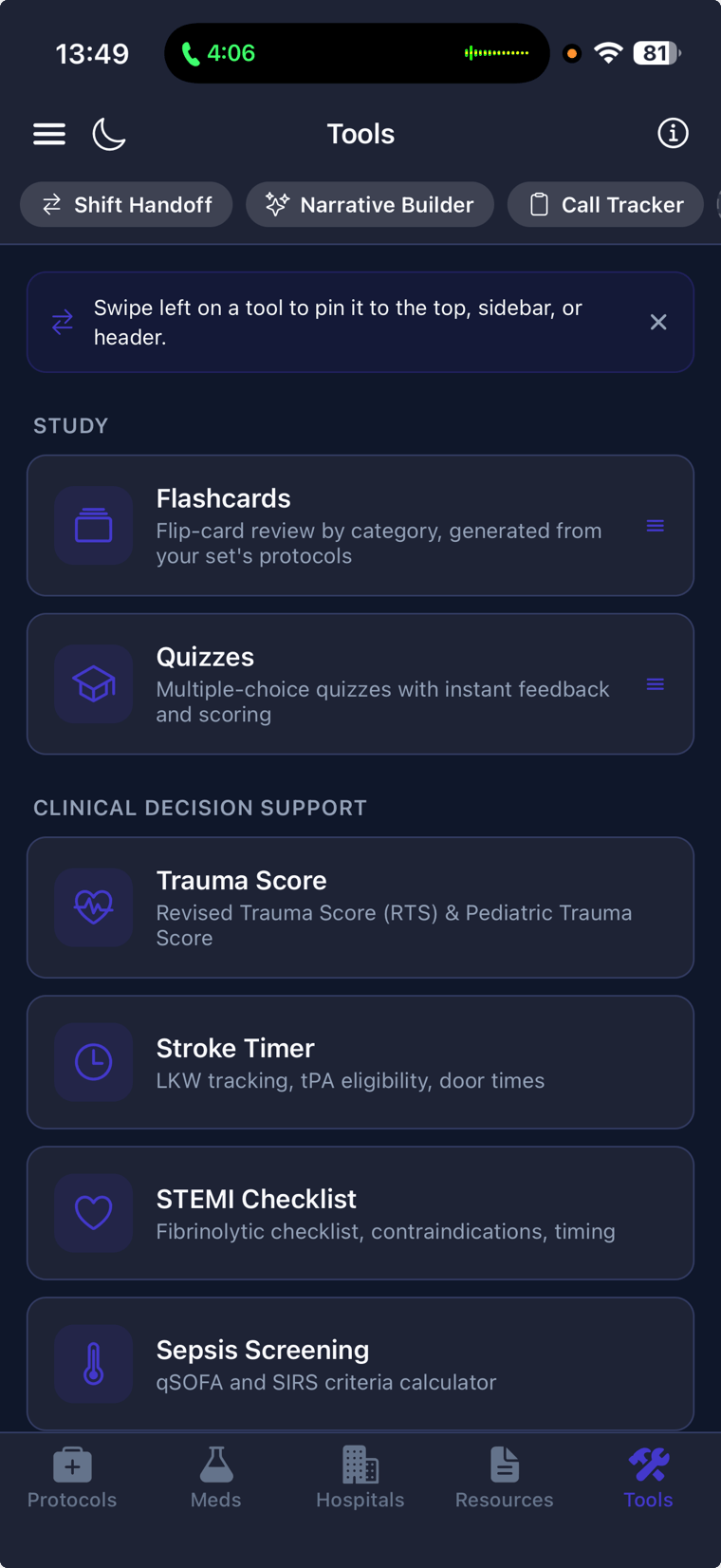
Pocket Protocols showing Nebraska's protocols, medications, and hospitals — searchable and fully offline.
What's covered in Nebraska
The protocol set serving Nebraska right now.
Nebraska Patient Care Protocols
Study tools for Nebraska Patient Care Protocols
A few real flashcards and quiz questions from Nebraska's own protocols — the full set, plus a spaced-review deck, is in the app.
Flashcards
Quik Trach: Target anatomical landmark
Landmark sites for chest needle decompression
Proximal Tibia IO Insertion Landmark
Why must the needle be inserted cephalad (over) the rib?
Proximal Humerus IO Insertion Landmark
Cricothyroid Membrane: Anatomical Landmark for Cricothyrotomy
Mechanisms of heat loss in hypothermia (4 types)
ALS provider TOR: 5 criteria that must ALL be met
Quiz questions
According to the Adult Cardiac Arrest protocol, what is the correct chest compression rate for manual CPR?
- 80–100 compressions per minute
- ✓ 100–120 compressions per minute
- 120–140 compressions per minute
- 60–80 compressions per minute
An ALS provider arrives on scene to find an adult patient in cardiac arrest. Asystole is confirmed in 2 separate leads, and no exclusion criteria are present. All 5 termination of resuscitation criteria are met. What is the NEXT required step before terminating resuscitation?
- Immediately terminate resuscitation and document time of death in the PCR
- ✓ Contact the Medical Director (preferred) or closest hospital, provide pertinent information, and request a physician or advanced practice provider order
- Initiate transport to the nearest emergency department and notify the hospital en route
- Continue resuscitation for an additional 30 minutes regardless of criteria being met
A patient is in refractory ventricular fibrillation. You have already defibrillated twice and administered Amiodarone 300 mg IV. The patient has a history of renal failure and you note wide QRS complexes and tall T-waves on the monitor. Which two medications should be considered for suspected hyperkalemia, and what is the correct concern about administering them together?
- Magnesium Sulfate 2g and Sodium Bicarbonate 50 mEq; they must never be given via the same route
- ✓ Calcium Gluconate 1g and Sodium Bicarbonate 50 mEq; they are incompatible and the line must be flushed between administrations
- Calcium Gluconate 1g and Magnesium Sulfate 2g; they must be diluted before administration
- Sodium Bicarbonate 50 mEq and Epinephrine 1 mg; they cancel each other's effects if given simultaneously
A patient achieves ROSC after a cardiac arrest. During post-resuscitation care, you note the EtCO2 reading is 55 mmHg. Your target EtCO2 is 35–45 mmHg. Which action is most appropriate according to the protocol?
- Increase the respiratory rate immediately to bring EtCO2 into the normal range
- ✓ Maintain the current respiratory rate of 6–12/min and avoid hyperventilation, as EtCO2 may remain elevated initially
- Administer sodium bicarbonate to correct the underlying acidosis
- Switch from BVM to a non-rebreather mask to reduce CO2 retention
You are treating a stable adult patient with a regular narrow-complex tachycardia (SVT) at a rate of 168 bpm. Vagal maneuvers have failed to convert the rhythm. What is the correct next step per protocol?
- Administer Diltiazem 0.25 mg/kg IV slow push
- ✓ Administer Adenosine 6 mg IV/IO rapid push with fluid bolus
- Perform synchronized cardioversion at 150-200 Joules
- Administer Adenosine 12 mg IV/IO rapid push with fluid bolus
A 68-year-old male presents with a heart rate of 44/min, BP of 78/50, and altered mental status. Atropine has been given twice with no improvement. According to the protocol, what is the most appropriate next intervention?
- Administer a third dose of Atropine 1 mg IV
- ✓ Initiate Transcutaneous Pacing
- Administer Midazolam 2 mg IV immediately
- Administer a Normal Saline bolus of 1 liter and reassess
Sourced from Nebraska's EMS authority
Pocket Protocols brings Nebraska's EMS protocols into a faster, fully offline app.
Nebraska protocols — FAQ
Are Nebraska's EMS protocols available offline?
Are the protocols specific to my county in Nebraska?
Is Pocket Protocols official, or affiliated with Nebraska?
How do Nebraska protocol updates reach the app?
Carry Nebraska's protocols on every call.
Download Pocket Protocols and keep your county's complete protocol set in your pocket — online or off.