New Jersey EMS protocols,
in your pocket.
Offline, county-specific protocols for New Jersey EMS providers — searchable, with a full medication reference, hospital finder, and study tools built in.
Covering 21 counties in New Jersey · Protocols current as of June 3, 2026
See it in the field
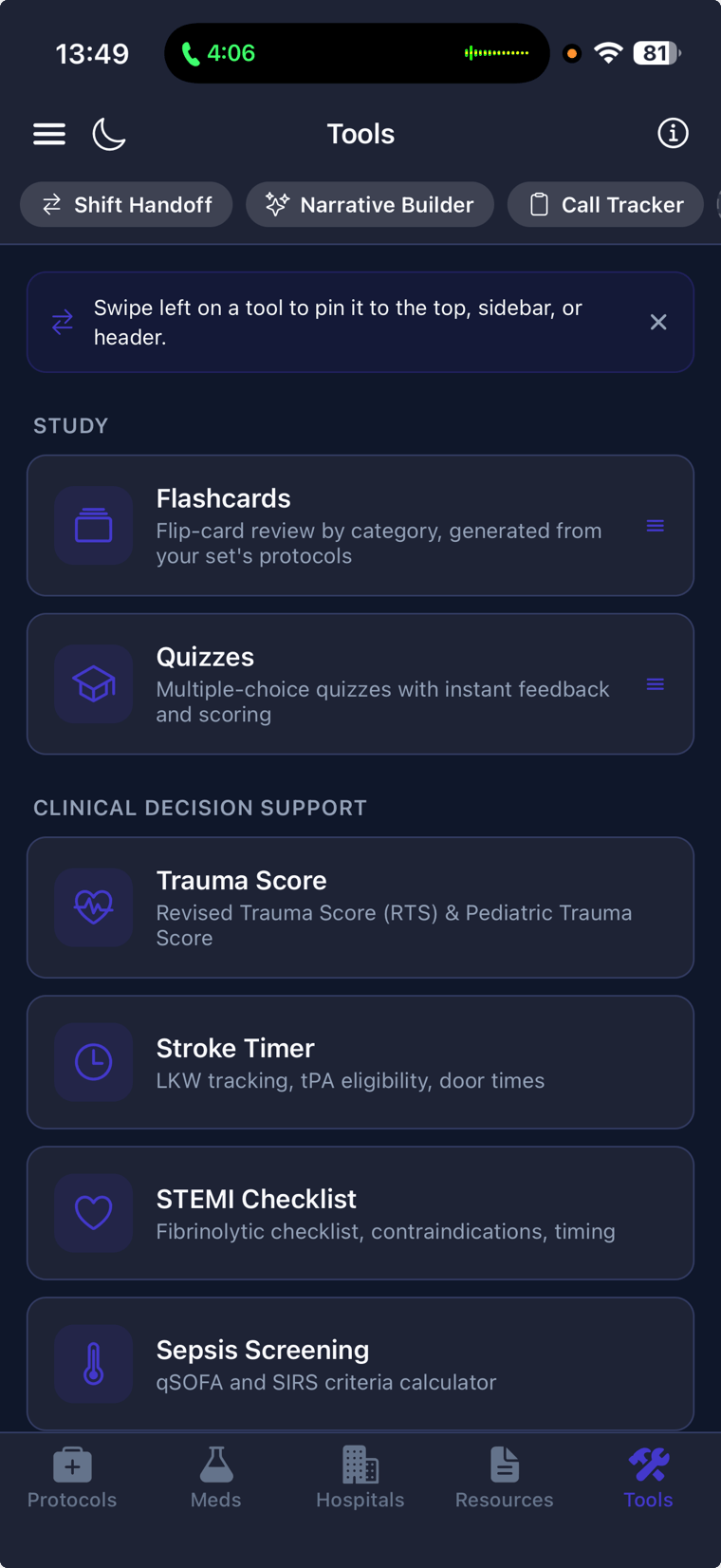
Pocket Protocols showing New Jersey's protocols, medications, and hospitals — searchable and fully offline.
What's covered in New Jersey
The protocol set serving New Jersey right now.
NJ EMS Clinical Practice Protocols & Guidelines
Study tools for NJ EMS Clinical Practice Protocols & Guidelines
A few real flashcards and quiz questions from New Jersey's own protocols — the full set, plus a spaced-review deck, is in the app.
Flashcards
Proximal Humerus IO (infant/child): How to identify the target landmark
Needle Thoracostomy: Adult Insertion Sites
Cricothyroid Membrane: Landmark Location
Anatomic Location of the Cricothyroid Membrane
What are the three abnormal neurological findings in extremities that require SMR?
Proximal Humerus IO (infant/child): What is the surgical neck and where is the IO insertion site relative to it?
Precordial lead placement: V1 and V2
What is Torticollis and why is it relevant to spinal assessment?
Quiz questions
An EMT responds to a 58-year-old male with chest pain. His O2 saturation is 97% and he is not in respiratory distress. What is the correct approach to oxygen administration per the ACS protocol?
- Apply oxygen at 15 L/min via non-rebreather mask immediately
- Apply oxygen at 2 L/min via nasal cannula as a precaution
- ✓ Do not administer oxygen, as the patient does not meet the criteria of dyspnea, hypoxia, or signs of heart failure
- Administer oxygen only after nitroglycerin is given
You are treating a 72-year-old female with weakness, diaphoresis, and nausea. She denies chest pain. According to the protocol, which of the following best explains why ACS should still be suspected?
- ✓ Elderly women rarely present with chest pain and may instead show atypical symptoms such as diaphoresis, weakness, and nausea
- Nausea and diaphoresis are pathognomonic for ACS in all age groups regardless of other symptoms
- The absence of chest pain rules out ACS, so another diagnosis should be sought
- Only male patients present atypically; women always present with classic chest pain
A patient is in cardiac arrest with ventricular fibrillation. Standard defibrillation has been attempted multiple times and the rhythm has never converted. Antiarrhythmic medications have been given without success. According to the protocol, what is the minimum number of unsuccessful shocks required before Double Sequential Defibrillation (DSD) may be considered?
- 2 shocks (standard pad placement only)
- 3 shocks (standard placement only, no vector change required)
- ✓ 4 shocks (3 regular and 1 with vector change)
- 5 shocks (4 regular and 1 with vector change)
According to the NJ EMS protocol, a 12-lead ECG should be obtained on all patients aged 35 or older presenting with chest discomfort. Which of the following presentations is ALSO listed as an indication for a 12-lead ECG acquisition?
- Isolated extremity pain following a fall
- ✓ Diabetic ketoacidosis or hyperglycemia
- Headache with photophobia
- Isolated lower back pain with a mechanism of injury
During a cardiac arrest resuscitation, you have been performing CPR for 20 minutes with an advanced airway in place. The ETCO2 reading is 8 mmHg. According to the NJ EMS protocol, what does this value indicate?
- The patient is hyperventilating and ventilation rate should be reduced
- ✓ The ETCO2 reading accurately predicts death and should be referenced in the Resuscitation Initiation and Termination Policy 8.12
- The endotracheal tube is likely dislodged and must be immediately repositioned
- ROSC is likely imminent and CPR should be paused to check for a pulse
You arrive on scene to find an LVAD patient who is unresponsive. The VAD pump sound is absent and your troubleshooting efforts to restart it have failed. Your ETCO₂ reading is 15 mmHg and the MAP is undetectable. What is the MOST appropriate next action according to the NJ EMS VAD protocol?
- Withhold CPR and consult the VAD coordinator before taking any further action
- ✓ Initiate CPR/ACLS immediately
- Apply the AED and defibrillate before initiating CPR
- Transport immediately without initiating CPR since LVAD patients should not receive chest compressions
Sourced from New Jersey's EMS authority
Pocket Protocols brings New Jersey's EMS protocols into a faster, fully offline app.
New Jersey protocols — FAQ
Are New Jersey's EMS protocols available offline?
Are the protocols specific to my county in New Jersey?
Is Pocket Protocols official, or affiliated with New Jersey?
How do New Jersey protocol updates reach the app?
Carry New Jersey's protocols on every call.
Download Pocket Protocols and keep your county's complete protocol set in your pocket — online or off.