New Mexico EMS protocols,
in your pocket.
Offline, county-specific protocols for New Mexico EMS providers — searchable, with a full medication reference, hospital finder, and study tools built in.
Covering 33 counties in New Mexico · Protocols current as of June 17, 2026
See it in the field
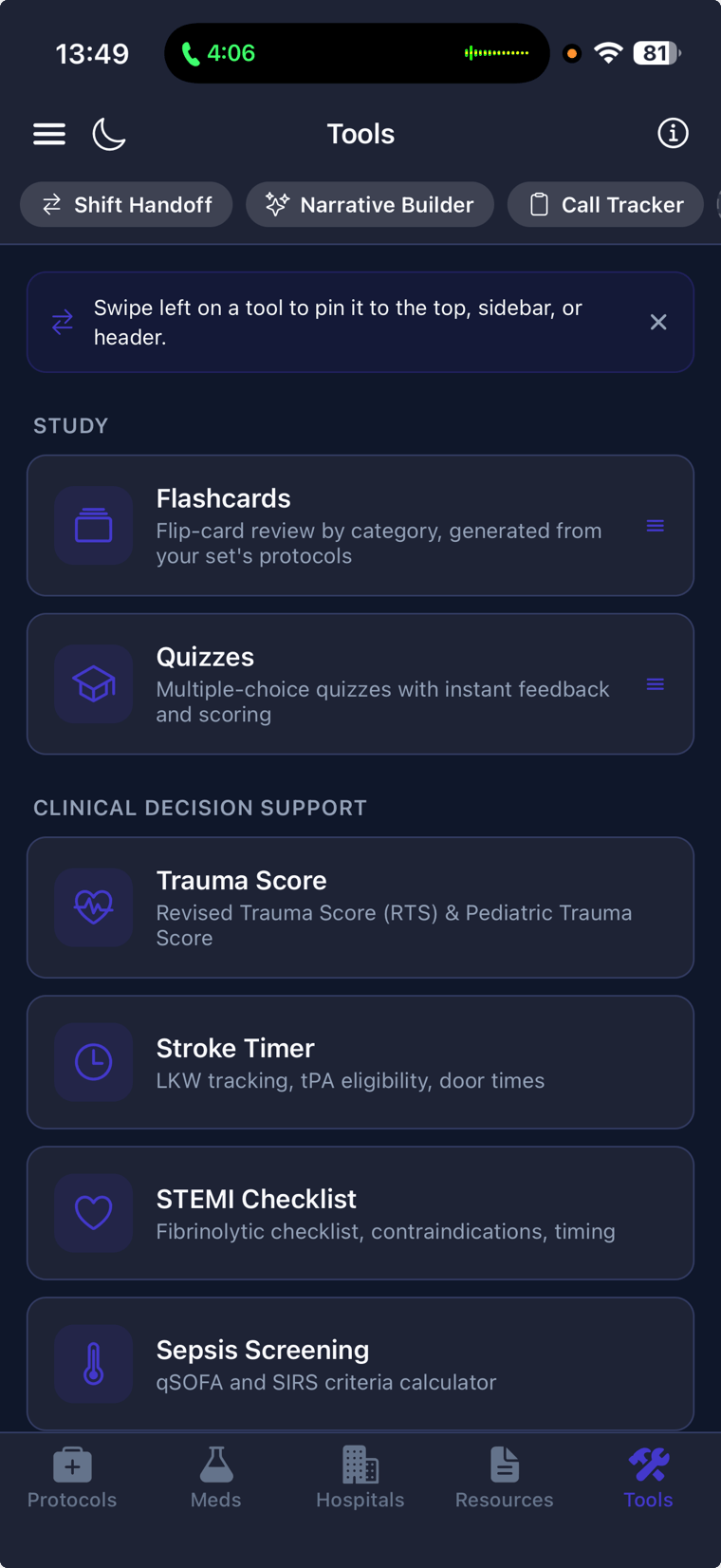
Pocket Protocols showing New Mexico's protocols, medications, and hospitals — searchable and fully offline.


What's covered in New Mexico
The protocol set serving New Mexico right now.
New Mexico EMS Guidelines
Study tools for New Mexico EMS Guidelines
A few real flashcards and quiz questions from New Mexico's own protocols — the full set, plus a spaced-review deck, is in the app.
Flashcards
Why should VF/pulseless VT patients be resuscitated on scene rather than during transport?
Medical Cardiac Arrest: Signs and Symptoms
Signs of hemodynamic instability in narrow complex tachycardia
Asystole: ECG confirmation criteria
Exception to the 'resuscitate on scene' rule for VF/pulseless VT
Hypothermia cardiac arrest: How many defibrillation attempts are made when core temp is < 30°C (86°F)?
Contraindication for narcotic analgesia (morphine/fentanyl) in chest pain
Manual defibrillation energy — Adult vs. Pediatric
Quiz questions
A 58-year-old male presents with chest pain and a blood pressure of 94/60 mmHg. He is nauseated and requesting pain relief. Which of the following is the most appropriate action per the New Mexico EMS Chest Pain guidelines?
- Administer Morphine 2 mg IV and titrate to effect
- Administer Fentanyl 50 mcg IV and titrate every 5 minutes
- ✓ Withhold narcotic analgesia due to systolic BP less than 100
- Administer Ondansetron 4 mg IV and then reassess for narcotic administration
According to the New Mexico EMS Medical Cardiac Arrest protocol, what should be done BEFORE attempting advanced airway management?
- Establish IV/IO access and administer epinephrine
- ✓ Perform 2 minutes of CPR while ventilating with a BVM using 100% oxygen
- Attach the AED and deliver up to three stacked shocks
- Obtain a 12-lead ECG to identify the underlying rhythm
You arrive on scene to find an unconscious adult patient in cardiac arrest. Your partner is performing CPR. According to the protocol, which of the following is the MOST appropriate concern regarding endotracheal intubation during CPR?
- Endotracheal intubation is contraindicated in all cardiac arrest patients
- ✓ Attempts at endotracheal intubation during CPR have been associated with unrecognized tube misplacement and prolonged interruptions in chest compressions
- Endotracheal intubation is only appropriate after ROSC is achieved
- Endotracheal intubation during CPR requires a Special Skill endorsement for all patients
According to the New Mexico EMS Treatment Guidelines for VF & VT (without a pulse), under what condition is it acceptable to perform chest compressions during transport?
- When the transport time to the hospital is less than 5 minutes
- ✓ When a mechanical chest compression device is utilized
- When two providers are available to alternate compressions
- When the patient has a witnessed cardiac arrest
You are treating an adult patient with a hemodynamically stable, regular narrow complex tachycardia who has not responded to Valsalva maneuvers. What is the correct initial adenosine dose and administration technique?
- 6.0 mg slow IV push over 30 seconds, followed by a 10cc normal saline flush
- ✓ 6.0 mg rapid IV push over 1-2 seconds, followed by a 20cc normal saline flush
- 12.0 mg rapid IV push over 1-2 seconds, followed by a 20cc normal saline flush
- 0.1 mg/kg rapid IV push, followed by a 20cc normal saline flush
You arrive on scene to find a severely hypothermic patient in cardiac arrest with ventricular fibrillation. You deliver one shock, but defibrillation is unsuccessful. Your monitor confirms the patient's core temperature is 28°C (82°F). What is the MOST appropriate next action per protocol?
- Continue to attempt defibrillation every 2 minutes following standard ACLS protocols.
- ✓ Withhold further defibrillation attempts and focus on CPR and rewarming until core temperature exceeds 30°C (86°F).
- Administer vasoactive medications immediately to support perfusion.
- Stop CPR and monitor only, as hypothermic patients rarely respond to resuscitation.
Sourced from New Mexico's EMS authority
Pocket Protocols brings New Mexico's EMS protocols into a faster, fully offline app.
New Mexico protocols — FAQ
Are New Mexico's EMS protocols available offline?
Are the protocols specific to my county in New Mexico?
Is Pocket Protocols official, or affiliated with New Mexico?
How do New Mexico protocol updates reach the app?
Carry New Mexico's protocols on every call.
Download Pocket Protocols and keep your county's complete protocol set in your pocket — online or off.