North Carolina EMS protocols,
in your pocket.
Offline, county-specific protocols for North Carolina EMS providers — searchable, with a full medication reference, hospital finder, and study tools built in.
Covering 100 counties in North Carolina · Protocols current as of June 17, 2026
See it in the field
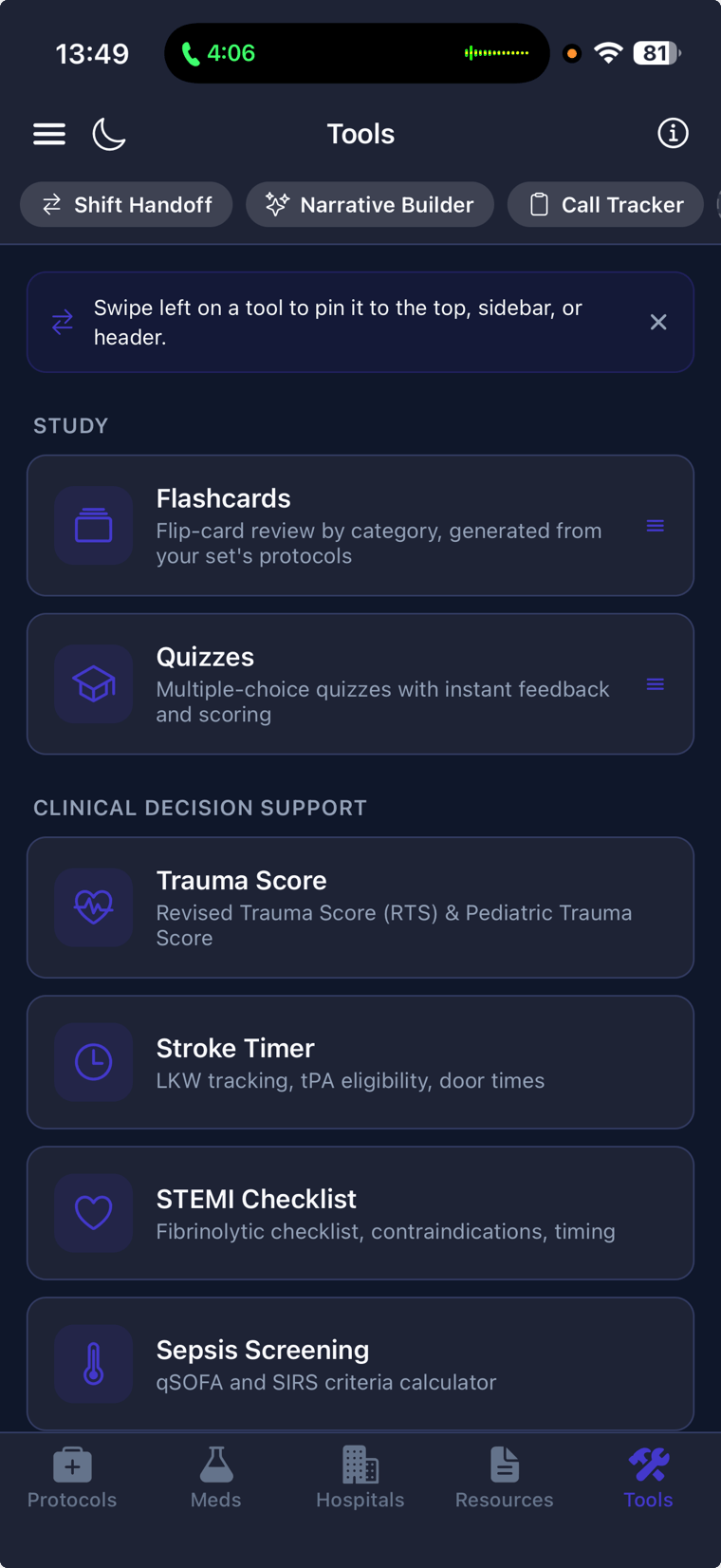
Pocket Protocols showing North Carolina's protocols, medications, and hospitals — searchable and fully offline.
What's covered in North Carolina
The protocol set serving North Carolina right now.
North Carolina State Protocols
Study tools for North Carolina State Protocols
A few real flashcards and quiz questions from North Carolina's own protocols — the full set, plus a spaced-review deck, is in the app.
Flashcards
Cauda equina syndrome: definition and symptoms
Symptomatic Bradycardia: Definition and Threshold HR
Unstable narrow tachycardia: definition and serious signs/symptoms
STEMI ECG Diagnostic Criteria
Unstable signs/symptoms indicating immediate cardioversion in wide complex tachycardia
Polymorphic QRS — definition
Who is a typical candidate for the Wearable Cardioverter-Defibrillator (WCD) vest?
Why is the ECG monitor contraindicated in Total Artificial Heart (TAH) patients?
Quiz questions
You are managing an adult patient in PEA arrest. An advanced airway (ETT) has been successfully placed and confirmed. According to protocol AC 1, what is the correct ventilation rate?
- ✓ 1 breath every 6 seconds (10 breaths/min) with continuous, uninterrupted compressions
- 1 breath every 5 seconds (12 breaths/min) with compressions paused for each breath
- 30:2 compression-to-ventilation ratio with pauses for ventilation
- 1 breath every 3 seconds (20 breaths/min) with continuous compressions
According to the AC 3 Adult Cardiac Arrest protocol, what is the correct compression-to-ventilation ratio when NO advanced airway is in place?
- 15:2
- ✓ 30:2
- 30:1
- Continuous compressions with 1 breath every 6 seconds
You are treating a stable adult patient with a wide, polymorphic tachycardia. A 12-lead ECG reveals a QT interval of 560 msec. Which medication should be considered according to this protocol?
- Amiodarone 150 mg IV/IO over 10 minutes
- Lidocaine 1–1.5 mg/kg IV/IO
- ✓ Magnesium 2 g IV/IO
- Adenosine 6 mg rapid IV push
You are treating a stable adult patient with a narrow-complex, IRREGULAR tachycardia at a rate of 138 bpm. After obtaining IV access and placing the patient on the cardiac monitor, what is the MOST appropriate next pharmacological intervention per protocol?
- Adenosine 6 mg IV rapid push with flush
- ✓ Diltiazem 0.25 mg/kg IV over 2–3 minutes, maximum 25 mg
- Amiodarone 150 mg in 100 mL D5W IV
- Synchronized cardioversion at 50–100J
You are treating a stable adult patient with a regular, wide-complex (≥0.12 sec) monomorphic tachycardia at a rate of 164 bpm. Per protocol AC 7, which of the following is the correct initial dose of adenosine if you elect to use it?
- 3 mg IV rapid push with flush
- ✓ 6 mg IV/IO rapid push with flush
- 12 mg IV/IO rapid push with flush
- 6 mg IV slow push over 2 minutes
According to the NC OEMS VF/Pulseless VT protocol, when should Epinephrine administration be delayed in a patient presenting in VF/VT?
- Until IV/IO access has been established for at least 5 minutes
- ✓ Until after the second defibrillation attempt
- Until antiarrhythmics have been administered first
- Until EtCO2 rises above 20 mmHg
Sourced from North Carolina's EMS authority
Pocket Protocols brings North Carolina's EMS protocols into a faster, fully offline app.
North Carolina protocols — FAQ
Are North Carolina's EMS protocols available offline?
Are the protocols specific to my county in North Carolina?
Is Pocket Protocols official, or affiliated with North Carolina?
How do North Carolina protocol updates reach the app?
Carry North Carolina's protocols on every call.
Download Pocket Protocols and keep your county's complete protocol set in your pocket — online or off.