North Dakota EMS protocols,
in your pocket.
Offline, county-specific protocols for North Dakota EMS providers — searchable, with a full medication reference, hospital finder, and study tools built in.
Covering 53 counties in North Dakota · Protocols current as of June 18, 2026
See it in the field
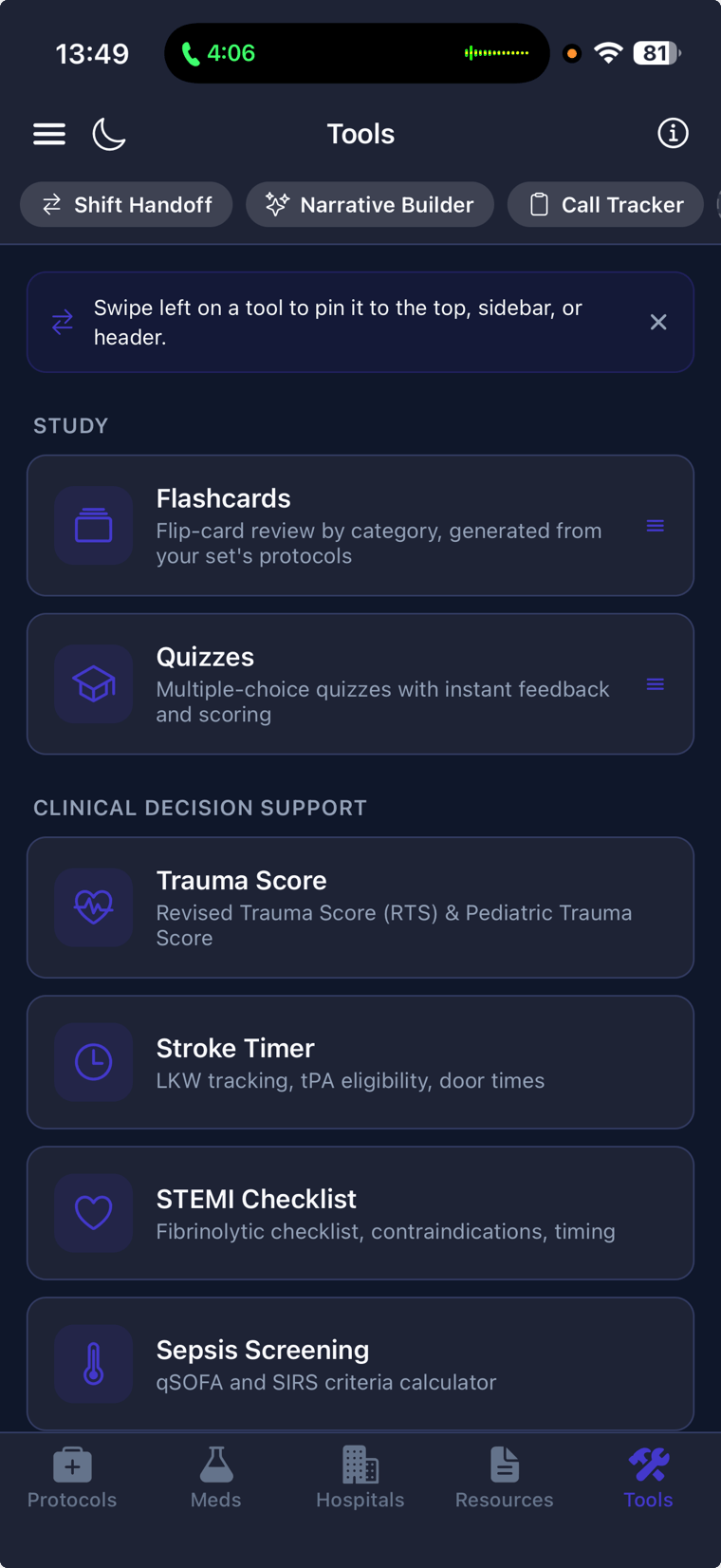
Pocket Protocols showing North Dakota's protocols, medications, and hospitals — searchable and fully offline.
What's covered in North Dakota
The protocol set serving North Dakota right now.
North Dakota EMS Treatment Guidelines/Protocols
Study tools for North Dakota EMS Treatment Guidelines/Protocols
A few real flashcards and quiz questions from North Dakota's own protocols — the full set, plus a spaced-review deck, is in the app.
Flashcards
12-Lead EKG: Precordial lead placement (V1–V6)
Saddle Distribution Sensory Loss: Significance in Back Pain
Unstable Tachycardia Criteria (Adult)
Bradycardia inclusion criteria
What are the three types of implantable ventricular assist devices (VADs)?
EtCO2 threshold for termination of resuscitation in asystole/slow wide complex PEA
Syncope occurring during exercise — clinical significance
Defibrillation energy setting — monophasic device in cardiac arrest
Quiz questions
A stable adult patient presents with a regular narrow complex tachycardia (SVT). Vagal maneuvers have failed. You administer adenosine 6 mg IV without conversion. What is your next step per protocol?
- Immediately proceed to synchronized cardioversion
- ✓ Administer adenosine 12 mg IV
- Administer diltiazem 0.25 mg/kg IV over 2 minutes
- Administer metoprolol 5 mg IV over 1–2 minutes
A 17-year-old male collapses while running a cross-country race. Bystanders state he lost consciousness briefly and fell to the ground. He is now awake and alert. According to the protocol, what does syncope occurring during exercise most likely indicate?
- Vasovagal response from dehydration
- ✓ An ominous cardiac cause requiring emergency department evaluation
- Orthostatic hypotension from transitioning positions
- Seizure activity that self-resolved
You arrive on scene to find an LVAD patient who is unresponsive with no detectable signs of life. The pump appears to be functioning — you can auscultate a hum. According to protocol, what is the most appropriate next action regarding CPR?
- Begin CPR immediately, as the patient is unresponsive with no signs of life.
- ✓ Do not perform CPR; evidence of a functioning pump is a contraindication to CPR per protocol.
- Begin CPR only after contacting medical direction, regardless of pump status.
- Perform CPR at a reduced rate to avoid damaging the device.
You arrive on scene to find an adult patient in cardiac arrest. Bystanders have been performing high-quality, uninterrupted CPR since before your arrival. According to the protocol, what is the most appropriate next action?
- Take over compressions from bystanders and perform 2 minutes of CPR before rhythm analysis
- ✓ Immediately proceed with rhythm analysis and defibrillation, if appropriate
- Establish IV/IO access and administer epinephrine before rhythm analysis
- Apply the mechanical CPR device before attempting defibrillation
You arrive on scene to find a 54-year-old male in cardiac arrest with asystole on the monitor. ALS resuscitation is initiated. After 20 minutes with no return of spontaneous circulation and no evidence of hypothermia, which additional finding is required before termination of resuscitation can be considered?
- Absence of a bystander witness to the arrest
- ✓ EtCO2 reading of less than 20 mmHg
- EtCO2 reading of less than 40 mmHg
- Patient age greater than 65 years
During LUCAS Device operation, the rhythm strip cannot be assessed during compressions. Per protocol, what is the maximum allowable interruption time if compressions must be paused for rhythm analysis?
- 5 seconds
- ✓ 10 seconds
- 15 seconds
- 20 seconds
Sourced from North Dakota's EMS authority
Pocket Protocols brings North Dakota's EMS protocols into a faster, fully offline app.
North Dakota protocols — FAQ
Are North Dakota's EMS protocols available offline?
Are the protocols specific to my county in North Dakota?
Is Pocket Protocols official, or affiliated with North Dakota?
How do North Dakota protocol updates reach the app?
Carry North Dakota's protocols on every call.
Download Pocket Protocols and keep your county's complete protocol set in your pocket — online or off.