Ohio EMS protocols,
in your pocket.
Offline, county-specific protocols for Ohio EMS providers — searchable, with a full medication reference, hospital finder, and study tools built in.
Covering 4 counties in Ohio · Protocols current as of July 1, 2026
See it in the field
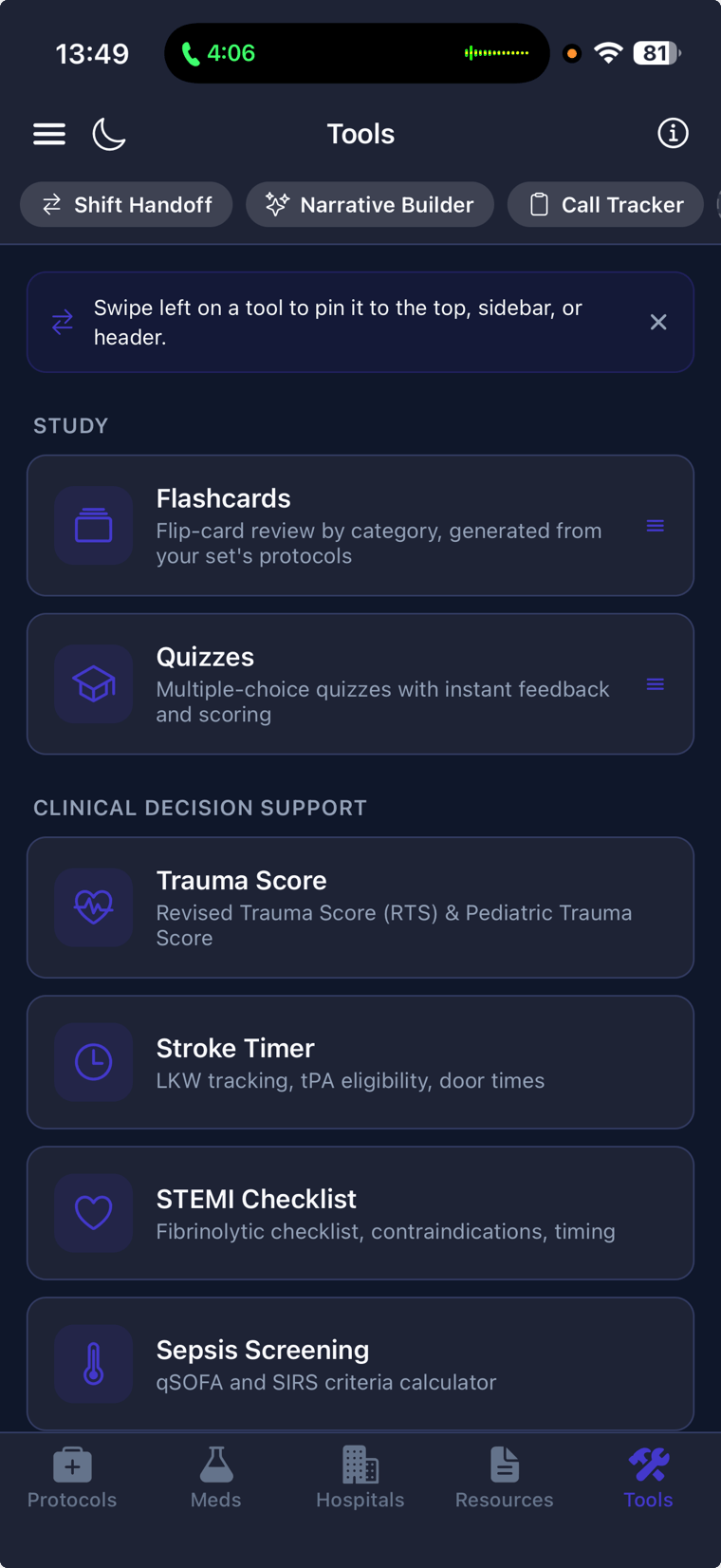
Pocket Protocols showing Ohio's protocols, medications, and hospitals — searchable and fully offline.
What's covered in Ohio
The protocol sets serving Ohio right now.
Central Ohio (OHEMS) Protocols
Lucas County EMS Protocols
Northeast Ohio Regional EMS Protocols
Southwest Ohio Regional EMS Protocols
Study tools for Central Ohio (OHEMS) Protocols
A few real flashcards and quiz questions from Ohio's own protocols — the full set, plus a spaced-review deck, is in the app.
Flashcards
What major cardiac protocol categories are covered in the OhioHealth EMS protocols?
Furosemide (Lasix) contraindications and key cardiac side effect
Environmental Hypothermia: Defibrillation limit during cardiac arrest
Initial synchronized cardioversion energy dosages by rhythm type
External Pacer: four indications for use
Induced hypothermia post-cardiac arrest: inclusion criteria
Nitroglycerine – Key Contraindication (Erectile Dysfunction Medications)
External Pacer: pad placement, starting amperage, and target rate
Quiz questions
A 58-year-old male presents with chest pain and a blood pressure of 108/72 mmHg. He reports taking sildenafil (Viagra) 48 hours ago. According to the OhioHealth Chest Pain - Cardiac protocol, what is the most appropriate action regarding nitroglycerin?
- Administer nitroglycerin 0.4 mg sublingually without concern, since 48 hours have passed
- ✓ Avoid or use nitroglycerin with extreme caution, as erectile dysfunction medication was used within the last 72 hours
- Administer nitroglycerin only after obtaining medical direction, since 48 hours is past the contraindication window
- Skip nitroglycerin and proceed directly to Morphine Sulfate for pain management
You are treating a chest pain patient whose pain is unrelieved after three doses of nitroglycerin. His BP is 96/60 mmHg. Per the OhioHealth Chest Pain - Cardiac protocol, what is the correct next step?
- Administer Morphine Sulfate 2 mg IV since pain is unrelieved
- ✓ Give a fluid bolus of 200 cc 0.9% Normal Saline due to hypotension
- Administer an additional fourth dose of nitroglycerin since the maximum is not yet reached
- Withhold all medications and expedite transport
You have a patient in symptomatic bradycardia with a heart rate of 38 BPM and signs of inadequate perfusion. You have administered the maximum dose of Atropine Sulfate with no improvement. Per the OhioHealth Bradycardia protocol, what is the maximum total dose of Atropine Sulfate that may be given, and what is the next intervention?
- Maximum of 2.0 mg; proceed to synchronized cardioversion
- ✓ Maximum of 3.0 mg; begin transcutaneous pacing
- Maximum of 1.0 mg; administer Lidocaine drip
- Maximum of 3.0 mg; administer Adenosine 6 mg rapid IV push
An elderly patient with chest pain has a blood pressure of 86/60 mmHg and reports taking sildenafil (Viagra) 48 hours ago. Which of the following medications from the protocol is MOST appropriate to administer?
- Nitroglycerine 0.4 mg sublingual, since 48 hours have passed since sildenafil use
- ✓ Morphine sulfate 2–5 mg IV for pain and anxiety relief
- Nitroglycerine 0.4 mg sublingual, repeating every 2–5 minutes as BP allows
- Ondansetron 4 mg IV to prevent nausea associated with the cardiac event
A patient achieves ROSC after a cardiac arrest and meets all inclusion criteria for the OhioHealth Induced Hypothermia protocol. During cooling en route to the hospital, the patient begins to shiver. What is the correct pharmacological intervention and its dosing limit per the protocol?
- Administer Morphine Sulfate 2 mg IV, may repeat to a maximum of 10 mg
- ✓ Administer Midazolam (Versed) 2–5 mg slow IV or IO, may repeat to 10 mg while maintaining systolic BP above 100 mmHg
- Administer Midazolam (Versed) 5–10 mg slow IV or IO, may repeat once
- Administer Diazepam 5 mg IV, may repeat to a maximum of 20 mg
A patient in acute pulmonary edema/CHF has a systolic BP of 110 mmHg. After initiating oxygen and IV access, the paramedic administers Nitroglycerin and Furosemide (Lasix) 40 mg IV (patient is not on a diuretic). The pulmonary edema is still not relieved. Which of the following correctly describes the next pharmacological option and its stopping criteria per protocol?
- Dopamine drip at 5–20 mcg/kg/min, titrated until BP is greater than 100 mmHg systolic
- ✓ Morphine Sulfate IV in 2 mg increments every 5 minutes, stopping if BP falls below 90 mmHg systolic, the patient becomes obtunded, or a maximum of 10 mg is reached
- Morphine Sulfate IV in 5 mg increments every 10 minutes, stopping when the patient's respiratory rate normalizes
- A second dose of Furosemide (Lasix) 80 mg IV over 8–10 minutes since the first dose was ineffective
Sourced from Ohio's EMS authority
Pocket Protocols brings Ohio's EMS protocols into a faster, fully offline app.
Ohio protocols — FAQ
Are Ohio's EMS protocols available offline?
Are the protocols specific to my county in Ohio?
Is Pocket Protocols official, or affiliated with Ohio?
How do Ohio protocol updates reach the app?
Carry Ohio's protocols on every call.
Download Pocket Protocols and keep your county's complete protocol set in your pocket — online or off.