Live in Pennsylvania
Pennsylvania EMS protocols,
Pennsylvania EMS protocols,
in your pocket.
Offline, county-specific protocols for Pennsylvania EMS providers — searchable, with a full medication reference, hospital finder, and study tools built in.
Protocols current as of June 18, 2026
See it in the field
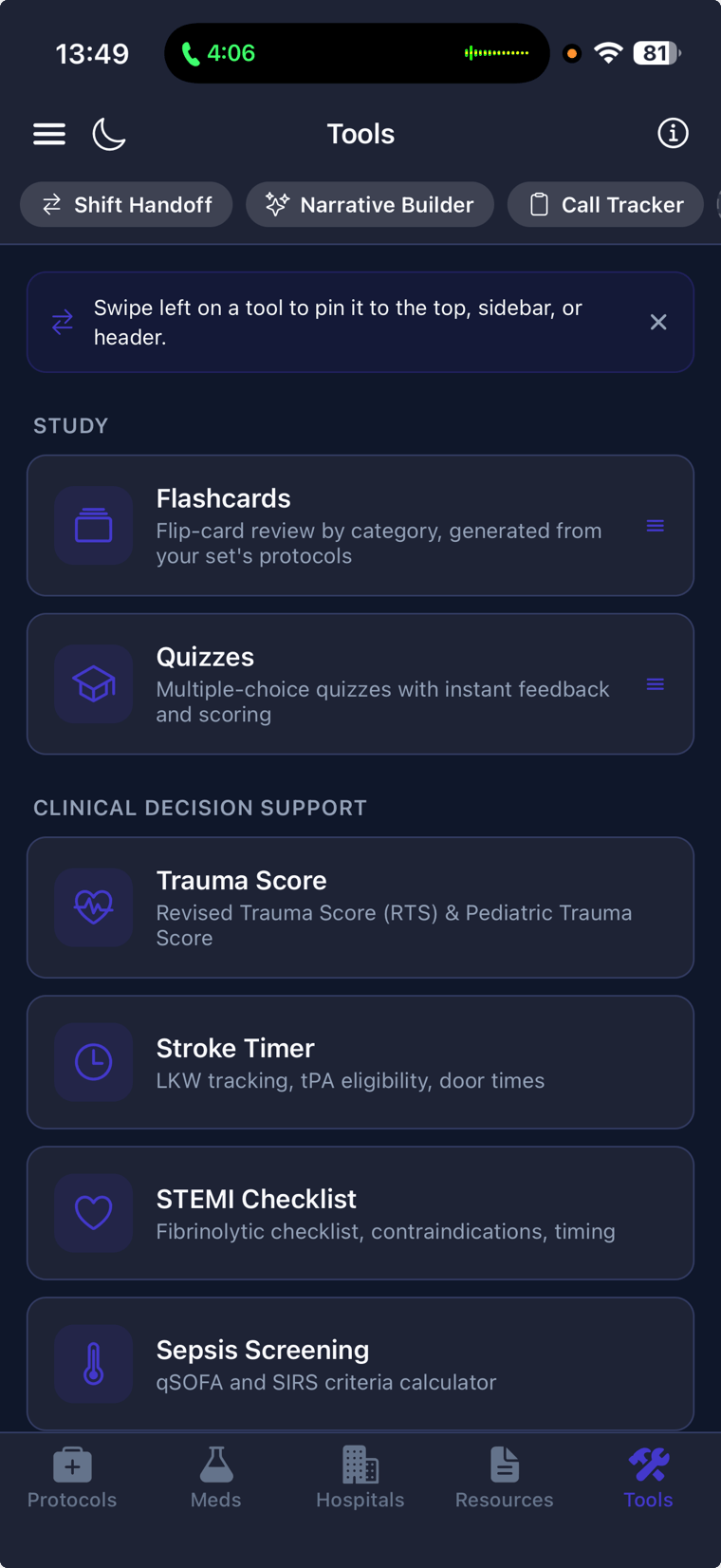
Pocket Protocols showing Pennsylvania's protocols, medications, and hospitals — searchable and fully offline.
Study tools for Pennsylvania ALS Protocols
A few real flashcards and quiz questions from Pennsylvania's own protocols — the full set, plus a spaced-review deck, is in the app.
Flashcards
Patient criteria required before contacting medical command to consider field termination of resuscitation
The patient must have no central pulse, no respiratory efforts, asystole or wide complex PEA at less than 60 BPM, and ETCO2 criteria must be met. EMS providers may only terminate resuscitation after receiving an order from a medical command physician.
Adult Bradycardia Protocol: Criteria for Activation
The protocol applies to adult patients with a heart rate less than 50 bpm with signs of poor perfusion. Exclusion criteria include pulseless patients (follow cardiac arrest protocol) and those with history or evidence of trauma (follow trauma protocol).
VAD Transport Equipment Requirements
When transporting a VAD patient, bring all equipment necessary for VAD function, including chargers, extra batteries, and back-up controller. Contact medical command if the VAD issue is suspected to be the cause of the patient's illness or for advice about the VAD.
ETCO2 threshold and time criteria for field termination of resuscitation
An ETCO2 less than 10 mmHg during CPR correlates with irreversible death; field termination may be considered after ETCO2 <10 mmHg following 20 minutes of continuous resuscitative efforts with no change in rhythm or perfusion, or after continuous high-quality resuscitation of 20 or more minutes without response. Field termination may also be considered with ETCO2 levels greater than 10.
Defibrillation energy for adult VF/VT
If VF/VT, defibrillate at 360 joules for the initial and all subsequent defibrillation attempts. Continue compressions while the defibrillator is charging.
VAD Preferred Transport Destination
Ideally, VAD patients should be transported to the facility that originally placed the VAD, or to a closer tertiary care facility that also places VADs. Medical command may order transport to either facility if the patient is deemed stable enough for the trip.
Which PA DOH ALS protocols address cardiac arrest, and how are they differentiated?
There are four cardiac arrest protocols: General Cardiac Arrest – Adult (3031a-1 thru 3031a-5), General Cardiac Arrest – Pediatric (3031p-1 thru 3031p-2), Cardiac Arrest – Traumatic (3032-1 thru 3032-3), and Cardiac Arrest (Hypothermia) (3035-1 thru 3035-2). Each is a distinct protocol addressing the specific etiology or patient population involved.
ETCO2 and ROSC: what sudden change indicates return of spontaneous circulation?
A sudden increase in ETCO2 by greater than 10 mmHg may indicate return of spontaneous circulation (ROSC). The optimal ETCO2 goal during CPR is greater than 20 mmHg, as ETCO2 level correlates with perfusion and cardiac output from CPR.
Quiz questions
You are on scene of a cardiac arrest. The patient has no central pulse, no respiratory effort, and is in asystole. After 22 minutes of continuous high-quality CPR, the ETCO2 reads 8 mmHg with no change in rhythm or perfusion. What is your NEXT most appropriate action per protocol?
- Immediately terminate resuscitation on your own judgment since ETCO2 is below 10 mmHg.
- Continue resuscitation and transport immediately since ETCO2 is below 10 mmHg.
- ✓ Contact medical command and request an order to terminate resuscitation.
- Attempt endotracheal intubation to improve ETCO2 before considering termination.
You arrive on scene to find a 58-year-old male found unresponsive in a frozen pond. He is pulseless and apneic. His body temperature is measured at 29°C (84.2°F). Which of the following actions is the MOST appropriate next step according to Protocol 3035?
- Withhold CPR and declare DOA because he has been in cold water too long
- ✓ Begin CPR, protect against heat loss, and transport ASAP to a facility capable of bypass rewarming
- Begin CPR and follow standard Cardiac Arrest Protocol #3031A/P only, since hypothermia protocols do not apply to submersion
- Begin CPR and focus on aggressive field rewarming before transport
You are transporting a VAD patient who appears stable. Medical command is contacted to assist with destination decisions. According to Protocol 5090, what is the IDEAL destination for this patient?
- The nearest emergency department regardless of VAD capability
- ✓ The facility that placed the VAD, or a closer tertiary care facility that also places VADs
- Any Level I trauma center
- The destination is solely at the paramedic's discretion without medical command input
You arrive on scene to find an adult patient with a heart rate of 38 bpm, acute altered mental status, and a blood pressure of 72/40 mmHg. According to the Adult Bradycardia protocol, what is your FIRST priority intervention?
- Administer Atropine 1 mg IV/IO immediately
- ✓ Begin transcutaneous pacing immediately without waiting for IV access
- Initiate IV/IO access, then administer Atropine before pacing
- Contact Medical Command before initiating any intervention
Which of the following scenarios is specifically listed in Protocol 3091 as a situation where field termination of resuscitation should NOT be performed?
- Cardiac arrest with asystole on the monitor after 25 minutes of CPR
- ✓ Cardiac arrest in a public place with bystanders present
- Wide complex PEA at a rate of 40 BPM with no central pulse
- Cardiac arrest where ETCO2 remains at 7 mmHg after 20 minutes of CPR
According to Protocol 3035, at what body temperature threshold does the Cardiac Arrest – Hypothermia protocol NO LONGER apply, and the provider should switch to standard Cardiac Arrest Protocol #3031A/P?
- Greater than 30°C (86°F)
- Greater than 32°C (89.6°F)
- ✓ Greater than 34°C (92.3°F)
- Greater than 36°C (96.8°F)
Sourced from Pennsylvania's EMS authority
Pocket Protocols brings Pennsylvania's EMS protocols into a faster, fully offline app.
Pennsylvania protocols — FAQ
Are Pennsylvania's EMS protocols available offline?
Yes. Download the protocol set for your area once and every protocol, medication, and hospital is available with no signal — built for basements, rural calls, and dead zones.
Are the protocols specific to my county in Pennsylvania?
Pocket Protocols covers selected areas in Pennsylvania today, not the whole state. Protocol sets are scoped by county, so a provider in a covered county gets exactly the set that governs where they respond, and you can add more than one if you work across areas. Other counties are added as their EMS authorities come on board.
Is Pocket Protocols official, or affiliated with Pennsylvania?
No — Pocket Protocols is an independent app and isn't affiliated with or endorsed by any EMS authority. We bring Pennsylvania's protocols into a faster, fully offline app and link the authority's own source for every set.
How do Pennsylvania protocol updates reach the app?
When the EMS authority publishes a new version and it goes live in Pocket Protocols, the app refreshes automatically — crews are never working from a stale copy. We monitor official sources for changes every day.
Carry Pennsylvania's protocols on every call.
Download Pocket Protocols and keep your county's complete protocol set in your pocket — online or off.