Saskatchewan EMS protocols,
in your pocket.
Offline, county-specific protocols for Saskatchewan EMS providers — searchable, with a full medication reference, hospital finder, and study tools built in.
Protocols current as of June 9, 2026
See it in the field
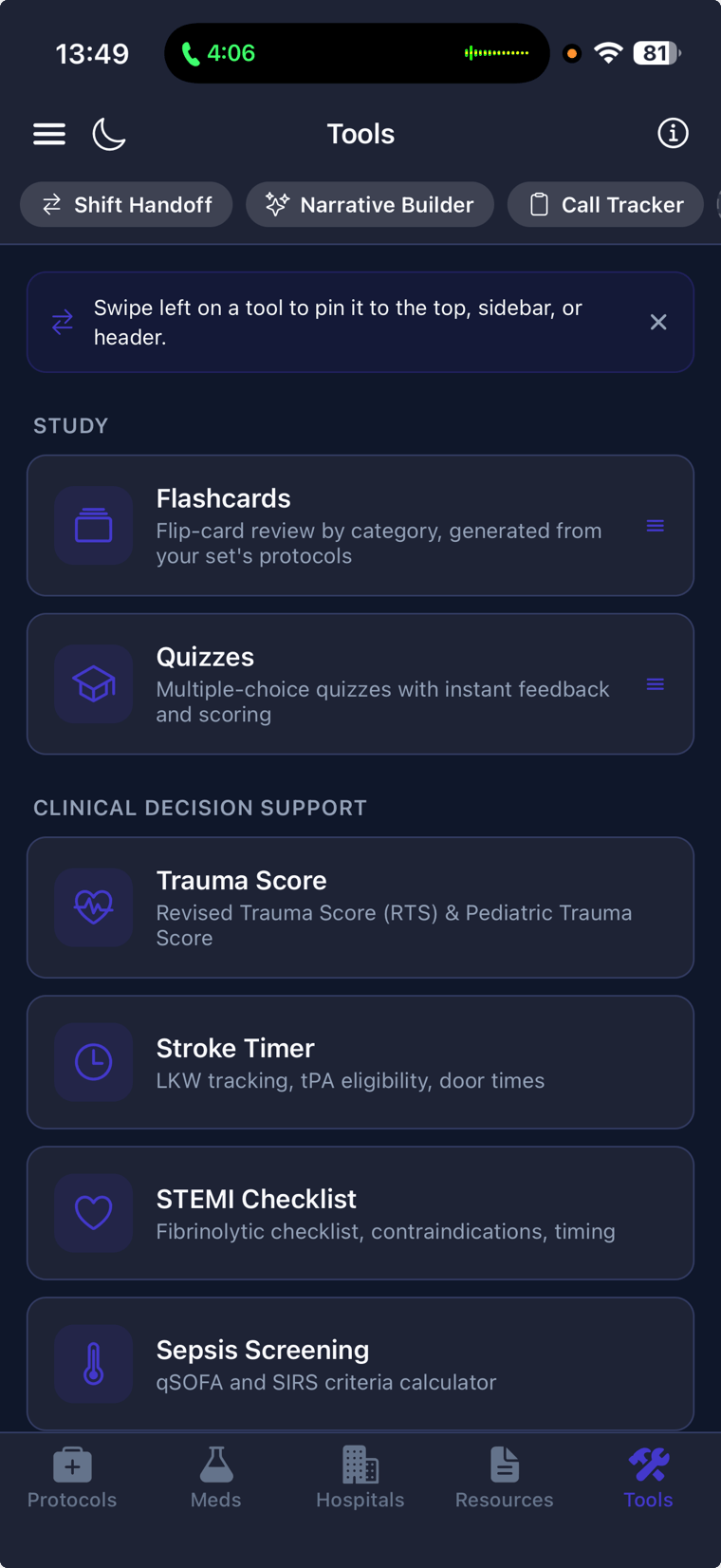
Pocket Protocols showing Saskatchewan's protocols, medications, and hospitals — searchable and fully offline.
What's covered in Saskatchewan
The protocol set serving Saskatchewan right now.
Saskatchewan Paramedic Clinical Practice Protocols
Study tools for Saskatchewan Paramedic Clinical Practice Protocols
A few real flashcards and quiz questions from Saskatchewan's own protocols — the full set, plus a spaced-review deck, is in the app.
Flashcards
Primary and alternative needle decompression insertion sites
IM injection approved sites
What above-rib instruction is given to avoid vessel laceration during chest decompression?
Anatomical landmark for the External Jugular Vein
IO proximal tibial insertion site — adult
Precordial lead V1 placement
IO proximal humerus insertion site — adult
Precordial lead V2 placement
Quiz questions
You arrive on scene to find a cardiac arrest patient in asystole. Bystanders report they called 911 immediately after the patient collapsed, and no CPR was attempted before your arrival. Your response time from the time of the call was 18 minutes. According to the Saskatchewan College of Paramedics 'Death in the Field' protocol, which action is MOST appropriate?
- Initiate full resuscitation efforts immediately, as field pronouncement is not permitted without OLMC contact.
- ✓ Pronounce the patient dead in the field, as there have been no resuscitation efforts for at least 15 minutes prior to arrival and the patient is in asystole.
- Initiate CPR and transport immediately, as the 15-minute rule only applies to traumatic arrests.
- Contact OLMC first before making any pronouncement decision, as this is mandatory in all cardiac arrest cases.
In the standard Lead II configuration described in the protocol, where is the 'Apex' electrode placed?
- Between the right nipple and the clavicle
- Between the left nipple and the clavicle
- ✓ Between the left nipple and the iliac crest
- On the anterior aspect of the left leg
A Primary Care Paramedic (PCP) arrives on scene with a patient experiencing chest pain. Regarding 12-Lead ECG, which action is the PCP authorized to perform according to the Saskatchewan College of Paramedics protocol?
- Acquisition and interpretation of the 12-Lead ECG
- ✓ Acquisition of the 12-Lead ECG only
- Interpretation of the 12-Lead ECG only
- Neither acquisition nor interpretation; this skill is restricted to Advanced Care Paramedics
According to the Saskatchewan College of Paramedics Manual Defibrillation protocol, which of the following is the ONLY indication for manual defibrillation?
- Cardiac arrest with asystole or pulseless electrical activity
- ✓ Cardiac arrest with ventricular fibrillation or pulseless ventricular tachycardia
- Symptomatic bradycardia unresponsive to atropine
- Unstable supraventricular tachycardia with a pulse
A patient is found unresponsive with a core temperature of 28°C and a heart rate of 38 bpm with hypotension. Which of the following is the most appropriate action regarding transcutaneous pacing (TCP)?
- Initiate TCP immediately, as the heart rate is below 60 bpm with hypotension
- ✓ TCP is contraindicated because this bradycardia is hypothermia-induced
- TCP is contraindicated because the patient is unconscious
- TCP is indicated because this is likely a third-degree AV block
An EMR arrives on scene with a patient experiencing chest pain. The patient does NOT have a personal nitroglycerine prescription. According to the Acute Coronary Syndromes protocol, what is the correct next step regarding nitroglycerine administration?
- Administer nitroglycerine from the unit's drug supply immediately
- ✓ Consult OLMC before proceeding with nitroglycerine
- Withhold nitroglycerine entirely, as EMRs are never permitted to administer it
- Assist the patient in obtaining nitroglycerine from a bystander
Sourced from Saskatchewan's EMS authority
Pocket Protocols brings Saskatchewan's EMS protocols into a faster, fully offline app.
Saskatchewan protocols — FAQ
Are Saskatchewan's EMS protocols available offline?
Are the protocols specific to my county in Saskatchewan?
Is Pocket Protocols official, or affiliated with Saskatchewan?
How do Saskatchewan protocol updates reach the app?
Carry Saskatchewan's protocols on every call.
Download Pocket Protocols and keep your county's complete protocol set in your pocket — online or off.