Tennessee EMS protocols,
in your pocket.
Offline, county-specific protocols for Tennessee EMS providers — searchable, with a full medication reference, hospital finder, and study tools built in.
Covering 95 counties in Tennessee · Protocols current as of June 18, 2026
See it in the field
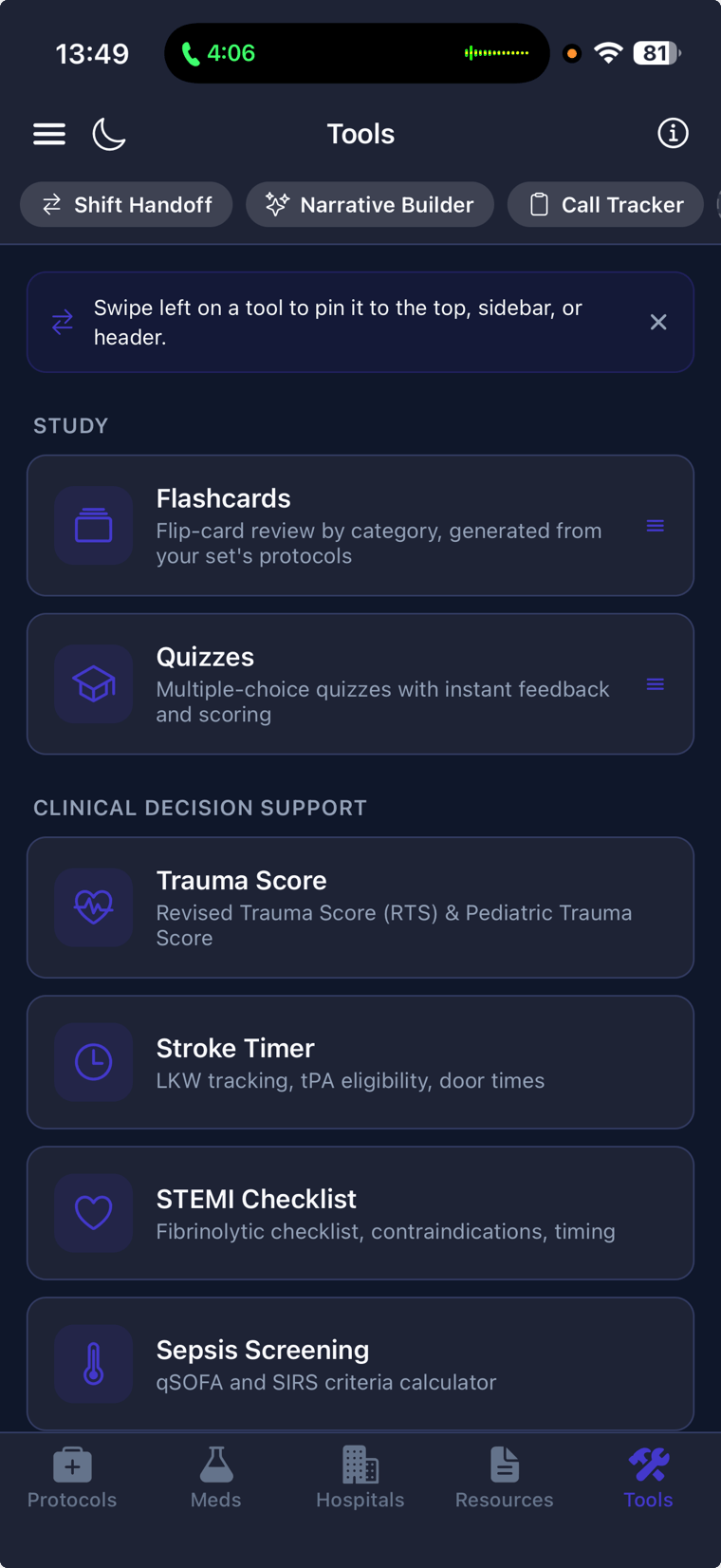
Pocket Protocols showing Tennessee's protocols, medications, and hospitals — searchable and fully offline.
What's covered in Tennessee
The protocol set serving Tennessee right now.
Tennessee State Guidelines
Study tools for Tennessee State Guidelines
A few real flashcards and quiz questions from Tennessee's own protocols — the full set, plus a spaced-review deck, is in the app.
Flashcards
Define 'para' and 'gravida' as used in the Placenta Previa history assessment.
Tracheal deviation in tension pneumothorax — which direction?
What does 'para' vs. 'gravida' mean in obstetrical assessment?
When is SOP #111 (Persistent V-Fib/Pulseless V-Tach) indicated?
Pulseless Electrical Activity (PEA) — Definition
SVT diagnostic criteria: adult vs. pediatric heart rate thresholds
ECG criteria for Ventricular Tachycardia with a Pulse (adult vs. pediatric)
Symptomatic Bradycardia: Defining Heart Rate Thresholds (Adult vs. Pediatric)
Quiz questions
According to SOP #101, what is the correct CPR compression rate for ALL ages using standard manual compressions?
- 80 per minute
- ✓ 100–110 per minute
- 90–100 per minute
- 110–120 per minute
You are an AEMT treating an adult patient with symptomatic bradycardia. The patient's fingerstick glucose reads 48 mg/dL. Per SOP #102, what is the correct action?
- Administer Atropine 0.5 mg IV immediately
- ✓ Titrate D10 slowly per hypoglycemia guidelines
- Administer Glucagon 1-2 mg IM
- Begin external transcutaneous pacing
According to SOP #106, which of the following PVC presentations meets the criteria for treatment intervention under this protocol?
- Unifocal PVCs at a rate of 10 per minute in an otherwise stable patient
- A single PVC in a non-AMI patient with no chest pain
- ✓ Multi-focal PVCs in any patient
- Unifocal PVCs at a rate of 12 per minute with no other symptoms
A paramedic is treating an adult patient in SVT. After a successful Valsalva maneuver setup, Adenosine 12 mg IV is administered but the rhythm does not convert. According to the protocol, what is the correct next step?
- Immediately proceed to synchronized cardioversion at 50 joules
- ✓ Repeat Adenosine at 12 mg once, flushed with 10 cc NS
- Administer Adenosine 6 mg as a lower repeat dose
- Administer Diazepam 2–5 mg IV and prepare for cardioversion
You are a Paramedic treating an adult patient in PEA arrest. What is the correct dose and concentration of EPINEPHrine to administer, and how should it be timed?
- EPINEPHrine 1:1,000 (1 mg/mL), 1 mg IVP/IO, administered every 5–10 minutes
- ✓ EPINEPHrine 1:10,000 (0.1 mg/mL), 1 mg IVP/IO, administered as early in the arrest as possible
- EPINEPHrine 1:10,000 (0.1 mg/mL), 0.5 mg IVP/IO, administered only after two rounds of CPR
- EPINEPHrine 1:1,000 (1 mg/mL), 0.01 mg/kg IVP/IO, administered every 3–5 minutes
A paramedic is treating an adult patient in Torsades de Pointes with a systolic BP of 80 mmHg and a heart rate of 178/min. After preparing for cardioversion and administering sedation, what is the correct initial cardioversion energy setting per this protocol?
- ✓ 50 joules, escalating to 100, then 200 as needed
- 100 joules, escalating to 200, then 360 as needed
- 200 joules synchronized, then escalate to 360
- 0.5–1 joule/kg, escalating as needed
Sourced from Tennessee's EMS authority
Pocket Protocols brings Tennessee's EMS protocols into a faster, fully offline app.
Tennessee protocols — FAQ
Are Tennessee's EMS protocols available offline?
Are the protocols specific to my county in Tennessee?
Is Pocket Protocols official, or affiliated with Tennessee?
How do Tennessee protocol updates reach the app?
Carry Tennessee's protocols on every call.
Download Pocket Protocols and keep your county's complete protocol set in your pocket — online or off.