Utah EMS protocols,
in your pocket.
Offline, county-specific protocols for Utah EMS providers — searchable, with a full medication reference, hospital finder, and study tools built in.
Covering 29 counties in Utah · Protocols current as of June 18, 2026
See it in the field
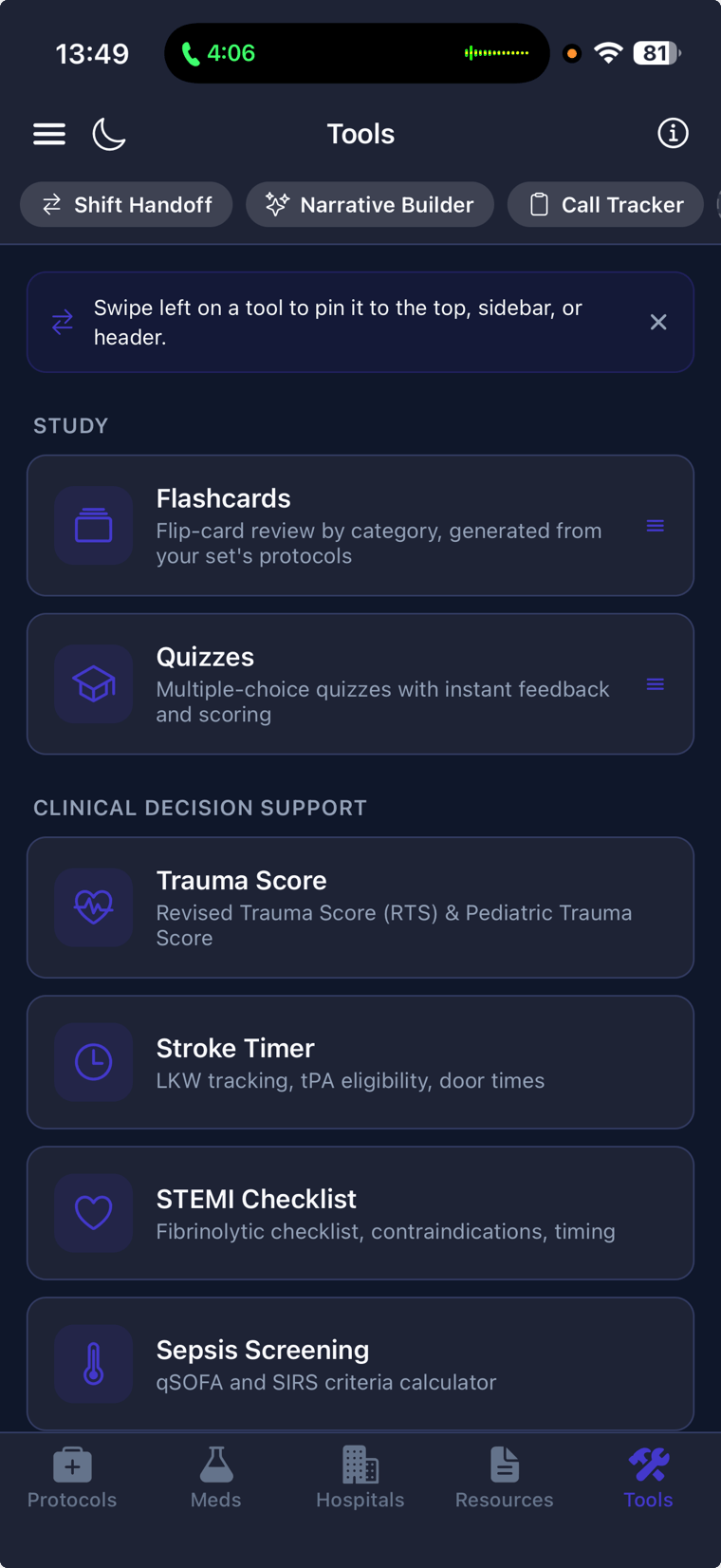
Pocket Protocols showing Utah's protocols, medications, and hospitals — searchable and fully offline.
What's covered in Utah
The protocol set serving Utah right now.
Utah EMS Protocol Guidelines
Study tools for Utah EMS Protocol Guidelines
A few real flashcards and quiz questions from Utah's own protocols — the full set, plus a spaced-review deck, is in the app.
Flashcards
Post-ROSC: target ETCO₂ and 12-lead EKG timing
Pediatric defibrillation energy dosing
Cardiogenic shock — fluid therapy decision
Resuscitation duration thresholds and survival rates
Adult synchronized cardioversion: energy settings for unstable tachycardia
Severe hypothermia cardiac arrest: defibrillation and transport considerations
FSED bypass criteria: Cardiac (STEMI)
Termination of CPR: minimum resuscitation duration requirements
Quiz questions
According to the Utah EMS Cardiac Arrest protocol, after delivering a defibrillation shock to an adult patient in VF, what should the provider do IMMEDIATELY?
- Check the patient's pulse for up to 10 seconds before resuming CPR
- ✓ Resume chest compressions and continue for 2 minutes before checking rhythm/pulse
- Administer 1 mg of epinephrine IV/IO before resuming compressions
- Recharge the defibrillator and prepare for a second immediate shock
You are managing an avalanche victim in cardiac arrest. The patient has a core temperature of 28°C (82.4°F), a burial time of 75 minutes, and a patent airway at extraction. Per the Utah Avalanche Victim Management protocol, what is the most appropriate transport destination?
- Nearest emergency department
- Freestanding Emergency Department (FSED)
- ✓ ECMO facility
- Trauma center
A Paramedic crew is transporting a patient with a suspected STEMI. According to the Utah EMS FSED bypass guidelines, what is the most appropriate destination?
- The nearest FSED, since it is staffed by Board-Certified Emergency Physicians
- The nearest FSED for initial stabilization, then transfer to a Cardiac Cath Lab facility
- ✓ A facility with a Cardiac Cath Lab, bypassing the FSED unless stabilization is needed
- Any emergency department, as STEMI care is not time-sensitive enough to dictate destination
EMS arrives on scene to find an adult patient apneic, pulseless, and in asystole after an unwitnessed cardiac arrest. Bystanders estimate the patient collapsed approximately 20 minutes before EMS arrived and no CPR was started. According to the protocol, which action is most appropriate?
- Begin resuscitation immediately since the arrest was unwitnessed.
- ✓ Withhold resuscitation because the unwitnessed arrest has an estimated collapse-to-CPR interval of >15 minutes with an initial rhythm of asystole.
- Begin resuscitation and terminate after 20 minutes of professional resuscitative efforts for a non-shockable rhythm.
- Contact OLMC immediately before making any decision about resuscitation.
You are an EMT treating a 55-year-old male with chest pain consistent with ACS. His SBP is 96 mmHg. He states he took sildenafil (Viagra) approximately 18 hours ago. Which action is most appropriate regarding nitroglycerin?
- Administer nitroglycerin 0.4 mg SL because his SBP is above 90 mmHg
- Administer nitroglycerin only after confirming IV access is established
- ✓ Do NOT administer nitroglycerin because he took an erectile dysfunction medication within the last 24 hours
- Administer half the standard nitroglycerin dose (0.2 mg) since it has been more than 12 hours since he took sildenafil
A post-ROSC adult patient is hypotensive despite fluid resuscitation. The paramedic is considering a vasopressor infusion. Per the protocol, what is the correct norepinephrine infusion range and target SBP for an adult?
- 0.01–0.5 mcg/kg/min titrated to SBP >90 mmHg
- ✓ 0.05–1 mcg/kg/min titrated up to 30 mcg/min to maintain SBP >100 mmHg
- 1–5 mcg/kg/min titrated to SBP >110 mmHg
- 0.05–1 mcg/kg/min titrated to maintain SBP >70 mmHg
Sourced from Utah's EMS authority
Pocket Protocols brings Utah's EMS protocols into a faster, fully offline app.
Utah protocols — FAQ
Are Utah's EMS protocols available offline?
Are the protocols specific to my county in Utah?
Is Pocket Protocols official, or affiliated with Utah?
How do Utah protocol updates reach the app?
Carry Utah's protocols on every call.
Download Pocket Protocols and keep your county's complete protocol set in your pocket — online or off.