Vermont EMS protocols,
in your pocket.
Offline, county-specific protocols for Vermont EMS providers — searchable, with a full medication reference, hospital finder, and study tools built in.
Covering 14 counties in Vermont · Protocols current as of June 18, 2026
See it in the field
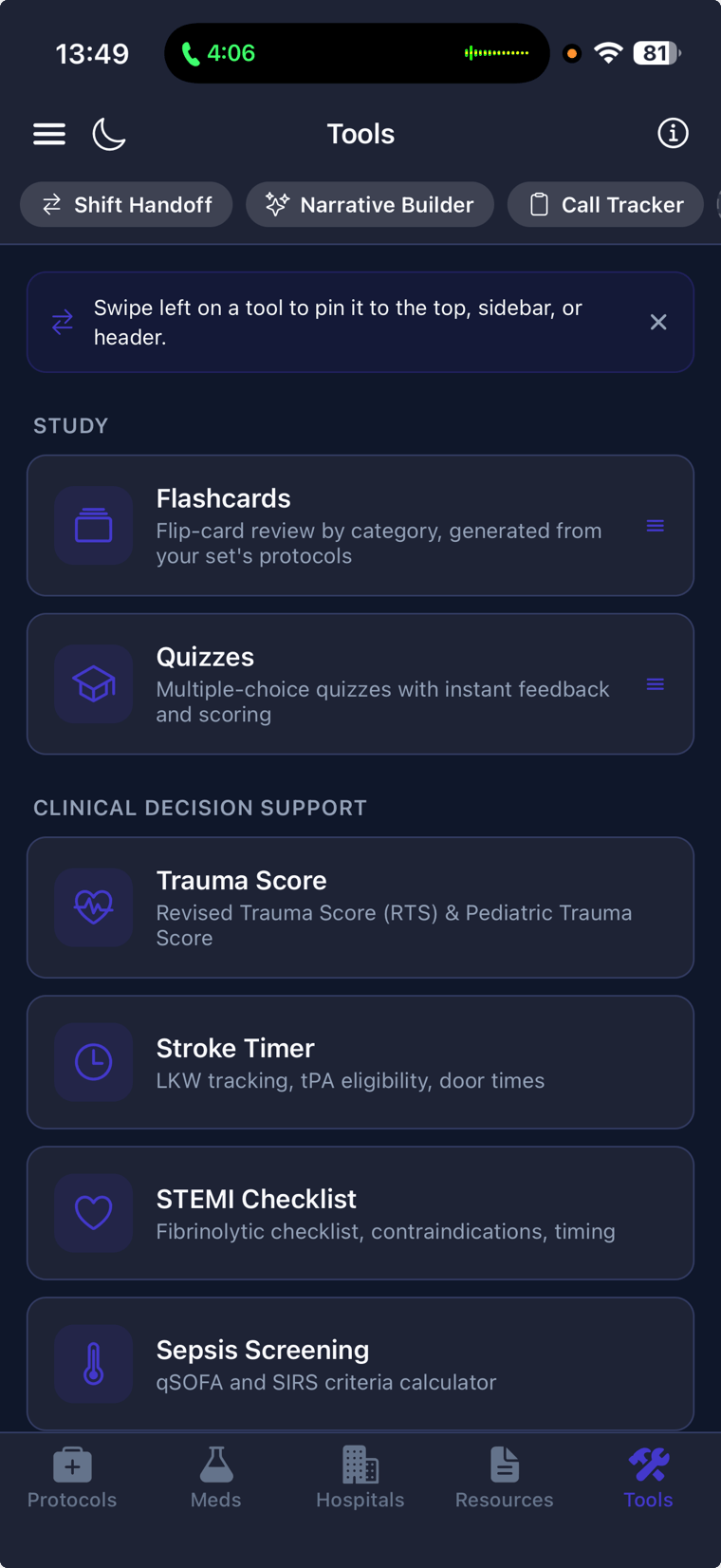
Pocket Protocols showing Vermont's protocols, medications, and hospitals — searchable and fully offline.
What's covered in Vermont
The protocol set serving Vermont right now.
Vermont EMS Protocols
Study tools for Vermont EMS Protocols
A few real flashcards and quiz questions from Vermont's own protocols — the full set, plus a spaced-review deck, is in the app.
Flashcards
Location of the cricothyroid membrane
Anatomical Location of the Cricothyroid Membrane
Adult NDT preferred insertion site
Thyromental distance threshold for difficult intubation
Precordial lead placement: V1 and V2
Precordial lead placement: V3, V4, V5, and V6
Vermont Statewide EMS Protocols 2025 – Section 3 covers which cardiac topics?
ECG findings indicating significant hyperkalemia
Quiz questions
According to the Vermont Statewide EMS Protocols 2025, which section covers both adult AND pediatric patients for Cardiac Arrest management?
- Section 3.2A only
- Section 3.2P only
- ✓ Both Section 3.2A and Section 3.2P
- Section 3.6 Team Focused CPR only
According to the Vermont EMS ACS Adult protocol, which of the following is a contraindication to administering aspirin to a patient with suspected Acute Coronary Syndrome?
- The patient already took aspirin at home prior to EMS arrival
- ✓ The patient has a history of anaphylaxis to NSAIDs
- The patient's blood pressure is greater than 180 mmHg systolic
- The patient is over 65 years of age with a history of diabetes
According to the Vermont EMS Acute Coronary Syndrome Adult protocol (3.0), what is the purpose of the blank page included in this section?
- To document patient care interventions performed on scene
- ✓ To insert the agency's local STEMI transport determination plan
- To record 12-lead ECG findings and rhythm interpretations
- To outline contraindications for aspirin administration
A paramedic is treating an adult patient with a heart rate of 42 bpm, hypotension, and altered mental status. Atropine has been administered twice without improvement. What is the most appropriate next intervention per protocol?
- Administer a third dose of atropine 1 mg IV/IO
- ✓ Transition to transcutaneous pacing
- Immediately start an epinephrine infusion at 10 mcg/min
- Administer glucagon 2–5 mg IV/IO
According to the Vermont EMS Adult Cardiac Arrest protocol, what is the correct BVM ventilation rate during high-performance CPR?
- 1 breath every 5 chest compressions
- ✓ 1 breath every 10 chest compressions without interrupting compressions
- 2 breaths every 30 chest compressions with a compression pause
- 1 breath every 15 chest compressions during recoil
An AEMT is managing an adult patient in cardiac arrest with a non-shockable rhythm. According to the protocol, when should epinephrine 1 mg IV/IO be administered?
- After the first 2-minute CPR cycle
- ✓ As soon as possible
- After the second defibrillation attempt
- Only after 4 cycles (8 minutes) of CPR
Sourced from Vermont's EMS authority
Pocket Protocols brings Vermont's EMS protocols into a faster, fully offline app.
Vermont protocols — FAQ
Are Vermont's EMS protocols available offline?
Are the protocols specific to my county in Vermont?
Is Pocket Protocols official, or affiliated with Vermont?
How do Vermont protocol updates reach the app?
Carry Vermont's protocols on every call.
Download Pocket Protocols and keep your county's complete protocol set in your pocket — online or off.