Wyoming EMS protocols,
in your pocket.
Offline, county-specific protocols for Wyoming EMS providers — searchable, with a full medication reference, hospital finder, and study tools built in.
Covering 23 counties in Wyoming · Protocols current as of June 18, 2026
See it in the field
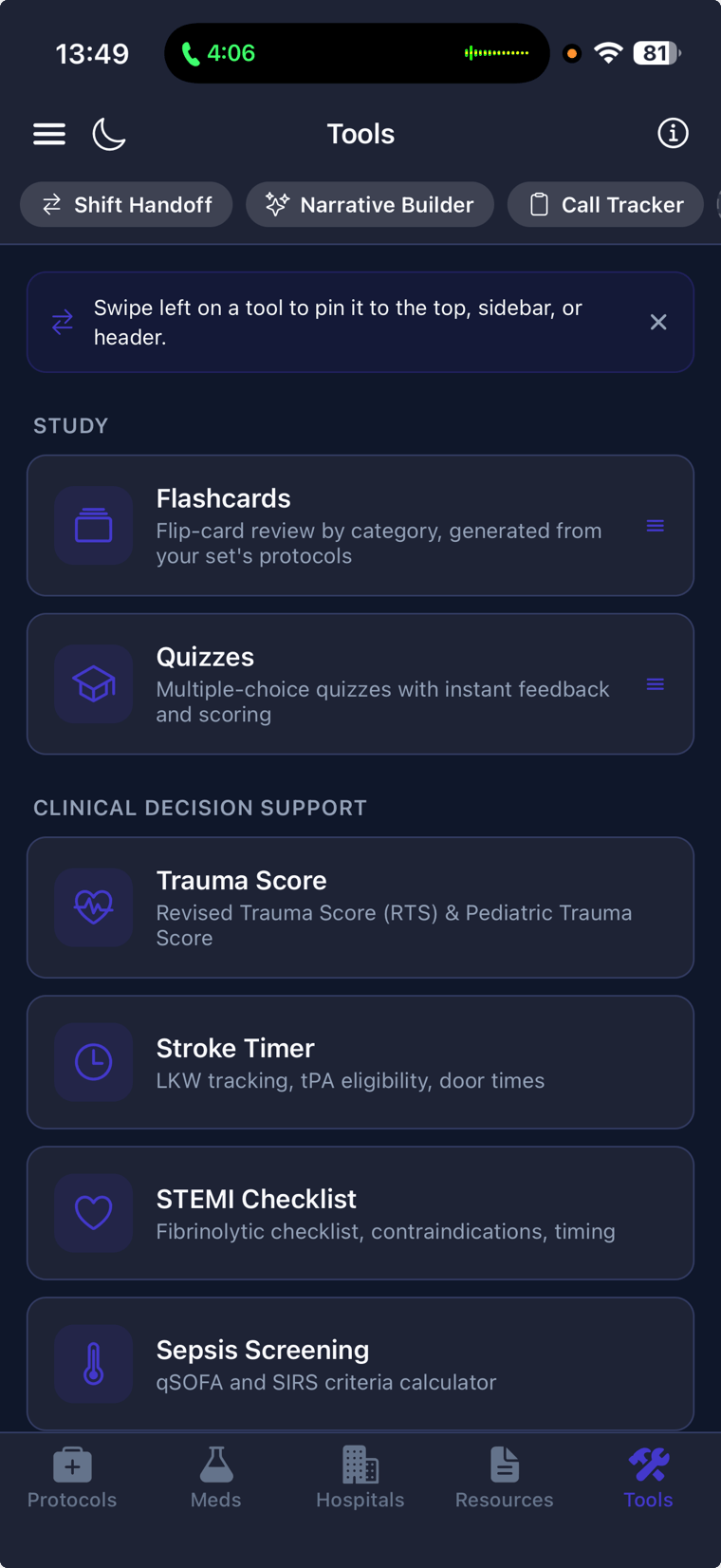
Pocket Protocols showing Wyoming's protocols, medications, and hospitals — searchable and fully offline.


What's covered in Wyoming
The protocol set serving Wyoming right now.
Wyoming Statewide Protocols
Study tools for Wyoming Statewide Protocols
A few real flashcards and quiz questions from Wyoming's own protocols — the full set, plus a spaced-review deck, is in the app.
Flashcards
Rule of Nines — adult TBSA values for the head, torso, and each leg
TBSA estimation for an obese adult (≈80 kg) — key differences from a standard adult
Obturator: function and critical step after tracheostomy insertion
What is the primary benefit of out-of-hospital 12-lead EKG acquisition in STEMI patients?
Definition of Syncope vs. Near Syncope
Bradycardia inclusion criteria (adult)
Which four cardiac arrest rhythms does this resuscitation protocol cover?
EtCO2 threshold for termination of resuscitation in asystole / slow wide complex PEA
Quiz questions
According to research cited in the NASEMSO National Model EMS Clinical Guidelines, what is a key benefit of performing out-of-hospital 12-lead ECGs and providing advance notification in STEMI patients?
- It eliminates the need for in-hospital cardiac catheterization
- ✓ It has been shown through systematic review and meta-analysis to improve outcomes for STEMI patients
- It replaces the need for serial ECGs in the prehospital setting
- It is only beneficial for anterior STEMI, not inferior STEMI
You arrive on scene to find a 17-year-old male who collapsed while playing basketball. Bystanders report he lost consciousness briefly but is now awake and alert. He denies any prior cardiac history. According to the protocol, what does syncope occurring during strenuous exercise most likely indicate, and what is the appropriate next step?
- Likely vasovagal syncope; consult medical direction regarding non-transport
- ✓ An ominous cardiac cause; the patient should be evaluated in the emergency department
- Dehydration-related syncope; administer a fluid bolus and reassess on scene
- A seizure disorder; refer to the Altered Mental Status Guideline
You are treating a stable adult patient with a regular narrow complex tachycardia (SVT). Vagal maneuvers have failed. You administer adenosine 6 mg IV without conversion. What is your next step per protocol?
- Immediately perform synchronized cardioversion
- ✓ Administer adenosine 12 mg IV
- Administer diltiazem 0.35 mg/kg IV over 2 minutes
- Administer amiodarone 150 mg IV over 10 minutes
According to the NASEMSO National Model EMS Clinical Guidelines for Cardiac Arrest, which of the following rhythm types are addressed within this resuscitation protocol?
- SVT, Atrial Fibrillation, Atrial Flutter, and Heart Block
- ✓ VF, VT, Asystole, and PEA
- Bradycardia, Tachycardia, Heart Block, and WPW
- VF, SVT, Asystole, and Sinus Arrest
You arrive on scene to find a 58-year-old male in cardiac arrest with no bystander CPR in progress. Your partner is retrieving the defibrillator. According to the protocol, what is your MOST appropriate immediate action?
- Wait for the defibrillator to arrive before initiating any intervention.
- ✓ Begin chest compressions immediately while your partner sets up the defibrillator.
- Establish IV access and administer epinephrine before starting compressions.
- Place an advanced airway first to ensure oxygenation prior to compressions.
A drowning victim is pulled from the water in cardiac arrest. According to the protocol, how should resuscitation be initiated, and how does this differ from standard cardiac arrest management?
- Use the standard CAB sequence: begin with 30 chest compressions before any rescue breaths
- ✓ Use the ABCs sequence: initiate 5 rescue breaths first, followed by 30 chest compressions, then continue at 30:2
- Use the ABCs sequence: initiate 2 rescue breaths first, followed by 30 chest compressions, then continue at 30:2
- Use the CAB sequence but administer supplemental oxygen between compression cycles
Sourced from Wyoming's EMS authority
Pocket Protocols brings Wyoming's EMS protocols into a faster, fully offline app.
Wyoming protocols — FAQ
Are Wyoming's EMS protocols available offline?
Are the protocols specific to my county in Wyoming?
Is Pocket Protocols official, or affiliated with Wyoming?
How do Wyoming protocol updates reach the app?
Carry Wyoming's protocols on every call.
Download Pocket Protocols and keep your county's complete protocol set in your pocket — online or off.